













A rolled leaf, a stolen future
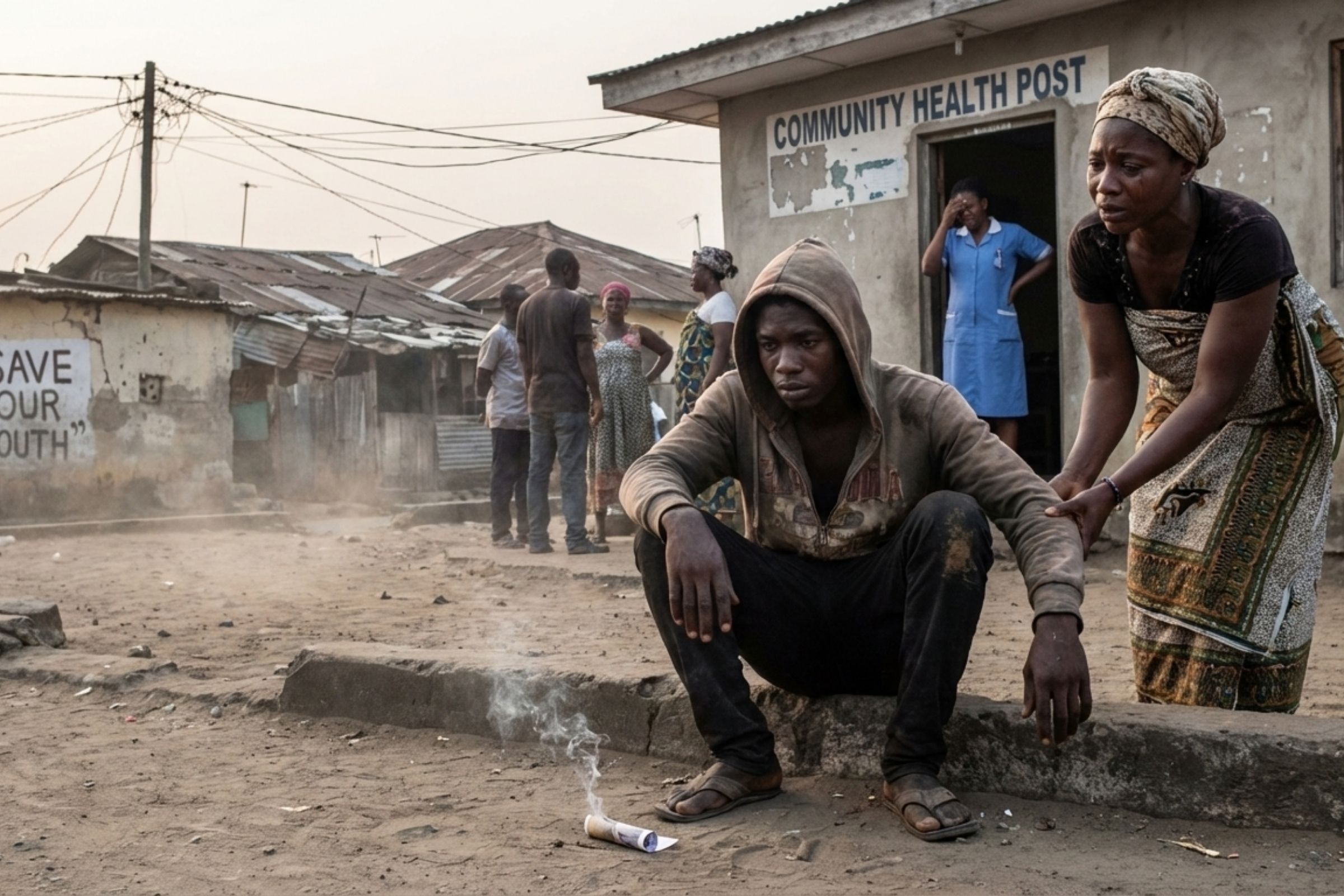
I keep thinking about how a society can collapse quietly. Not with bombs. Not with tanks. With a small rolled leaf passed from hand to hand, smoked in full daylight, and strong enough to turn a living young person into a moving funeral.
That is what “kush” is doing across West Africa. Sierra Leone has been described as the epicenter. Liberia is severely affected too. And what makes this crisis different from the drug waves we thought we understood is not just that kush is addictive. It is that kush is chemically unpredictable. It is engineered to overpower the human body, not to “calm” it.
What kush really is
Kush is often spoken about as if it is simply another form of cannabis. That misunderstanding is part of the danger.
In some samples, kush has been described as a mixture involving cannabinoids and synthetic opioids. Cannabinoids are the chemicals that affect the brain and body in cannabis. Your body even produces its own natural versions that help regulate mood, pain, sleep, appetite, and memory. But kush is not just about plant chemistry. It is also about lab chemistry, and lab-made compounds can be far stronger and far more erratic than anything a plant produces.
The most frightening detail is this: testers found nitazenes in some kush samples. Nitazenes are synthetic opioids, and one of the nitazenes detected has been described as being up to 25 times stronger than fentanyl. When you hear that, you should not think “stronger high.” You should think “smaller margin between breathing and not breathing.”
Why “25 times stronger than fentanyl” should terrify you
To understand the warning, you have to understand fentanyl.
Fentanyl is a medical-grade opioid painkiller used by doctors in hospitals for severe pain, major surgery, and cancer care. It exists for a reason. It works. But it is dangerous in the wrong dose because opioids do more than reduce pain. They also slow the part of the brain that controls breathing.
That is why fentanyl has become infamous globally. A tiny amount can cross the line from “feels something” to “stops breathing.” And people often don’t even know it is present because fentanyl is sometimes mixed into other drugs.
Now imagine something that hits the body up to 25 times harder than that.
If a speck of fentanyl can stop breathing, then an even tinier speck of a potent nitazene can do the same, faster and with less warning. That is why kush can kill even experienced users. Not because they are “weak.” But because the dose that becomes fatal can be unbelievably small, and the person smoking has no way of knowing the strength of what is in the mix that day.
Sierra Leone’s warning flare
Kush first appeared in Sierra Leone in 2022, and in only a short time it has been described as a deadly plague. The speed of its spread matters because it tells you something important: this is not a slow cultural drift toward a new habit. This is a market expansion.
Researchers describe a crisis so severe that fatalities overwhelmed mortuary systems, forcing emergency group cremations, and in extreme reports even leading to bodies being abandoned in streets. You read that and you realize this is no longer only a personal tragedy. It is a national trauma.
The story on the ground is equally brutal. In places like Kolabouy, a crossroads in the north, young people have been described smoking kush openly. A resident puts it plainly: they do nothing all day, and the drug makes them numb. Numbness sounds like peace until you realize it is just life switching off while the heart keeps beating.
Even the mental health system has been hit hard. One striking indicator reported is that in 2023, 59% of patients admitted to Sierra Leone’s only psychiatric hospital had used kush. That is not a statistic you can shrug off. That is a portrait of a society bleeding from the inside.
West Africa’s new drug map
From Sierra Leone, kush has spread rapidly into neighboring countries, including Guinea-Conakry, Liberia, Guinea-Bissau, the Gambia, and Senegal. That spread represents a major shift in drug use patterns, and it has also carried a cruel economic logic.
Doctors and researchers have pointed out something many poor communities already know instinctively: cocaine is often associated with people who can afford it. Kush is the drug of the poor. It is cheap enough to become normal. In Dakar, for example, doses have been described as selling for less than a dollar, with dealers abundant in areas popular with young people.
And the crisis is reaching schools too. A survey by UNODC and the government of Guinea-Conakry reported that 1% of students aged 15 to 18 had used kush, placing it among the most widely used substances in that age group after cannabis and inhalants like glue. When a drug makes it into the routines of teenagers, the country is no longer dealing with “bad choices.” It is dealing with a pipeline.
Liberia: the same fire, a different fuel
Liberia’s situation demands special attention because Liberia carries its own unique vulnerabilities. A country can survive war and still suffer from the aftershocks of trauma, unemployment, broken family structures, and a youth population searching for escape from a hard reality. Kush arrives in that environment like a match dropped into dry grass.
Liberia has declared a public health emergency, and that decision matters because it signals something rare: a willingness to name the problem as national, not individual. But declarations do not save lives by themselves. If Sierra Leone is the warning flare, Liberia is the test of whether West Africa can learn fast enough to prevent the worst outcomes from repeating across borders.
What also makes Liberia’s case urgent is that kush’s supply chain has been described as international. Researchers have pointed to ingredients coming from places like China and the Netherlands, and probably the United Kingdom, moving via postal services and maritime routes into Sierra Leone, described as the main producing country. That means the drug is not just “homegrown chaos.” It is connected to global systems of shipping, commerce, and criminal entrepreneurship.
Then there is the detail that sounds too dark to be real, yet appears in serious discussion: a study by scholars at the University of Freetown has claimed that on some occasions human bone powder is added to the mixture for its sulfur content, and that traffickers have been arrested for digging up corpses in cemeteries. Whether or not that is widespread, the mere fact that it is plausible enough to be investigated tells you how far this market will go to intensify effects and trap users.
Naloxone: the thin line between death and a second chance
If synthetic opioids are involved in kush, then West Africa needs to treat overdoses as time-sensitive medical emergencies, not moral failures.
Naloxone is a medicine that can quickly reverse an opioid overdose. In an overdose, opioids can shut down breathing. Naloxone works by knocking opioids off the brain’s receptors and temporarily blocking them, giving the person a chance to breathe again.
In everyday terms, it is a rescue tool. It is the difference between a funeral and another sunrise.
When an overdose is suspected, the priority is to call for emergency help immediately, give naloxone if available, support breathing if trained, and stay with the person. With extremely strong opioids, multiple doses may be needed, and naloxone can wear off before the opioid does, which is why medical care is still essential even after someone “wakes up.” The goal is not just revival. The goal is survival.
Revolutionary solutions that match the scale of the crisis
West Africa does not need another season of speeches. It needs a counteroffensive.
The first revolution is truth. Governments must invest in drug testing and early warning systems so communities are not left drowning in rumors. If a substance changes composition, people need to know immediately. If nitazenes are detected, that should trigger an emergency public alert, not whisper networks.
The second revolution is survival infrastructure. Naloxone should be widely available where overdoses are likely, and people should be trained to use it without fear or shame. This is not about “encouraging” drug use. It is about refusing to let addiction become a death sentence. Alongside naloxone, health systems must build overdose response protocols that treat users as patients, because a person who survives today is a person who can recover tomorrow.
The third revolution is treatment with dignity. Rehabilitation cannot be a privilege for the few or a punishment for the poor. Countries need accessible detox support, mental health care, and long-term reintegration, including family counseling, skills training, and pathways back into school or work. Addiction thrives where life feels like a dead end. Recovery becomes possible when a future feels reachable.
The fourth revolution is economic. Kush is cheap because despair is cheap. West Africa must talk about youth employment not as a political slogan but as a health intervention. When young people have work, mentorship, and purpose, the market for numbness shrinks.
The fifth revolution is regional power. Kush crosses borders. So should the response. Liberia and Sierra Leone, alongside neighbors, need joint intelligence on supply chains, coordinated maritime and postal screening, and shared data on what is being found and where. If the ingredients are coming through global routes, then the response must also reach beyond borders through diplomacy, enforcement cooperation, and pressure on supply points.
And finally, the deepest revolution is cultural. Communities must stop treating addiction like a private embarrassment to be hidden, because secrecy is where overdoses flourish. Parents, pastors, imams, teachers, artists, and local leaders need to make one message loud: we will not shame you into silence. We will fight for your life.
Because kush is not only a drug. It is a story about whose life gets protected and whose life gets written off. And if West Africa is serious about protecting its future, then it must choose, urgently and publicly, to stop writing off its young people.