














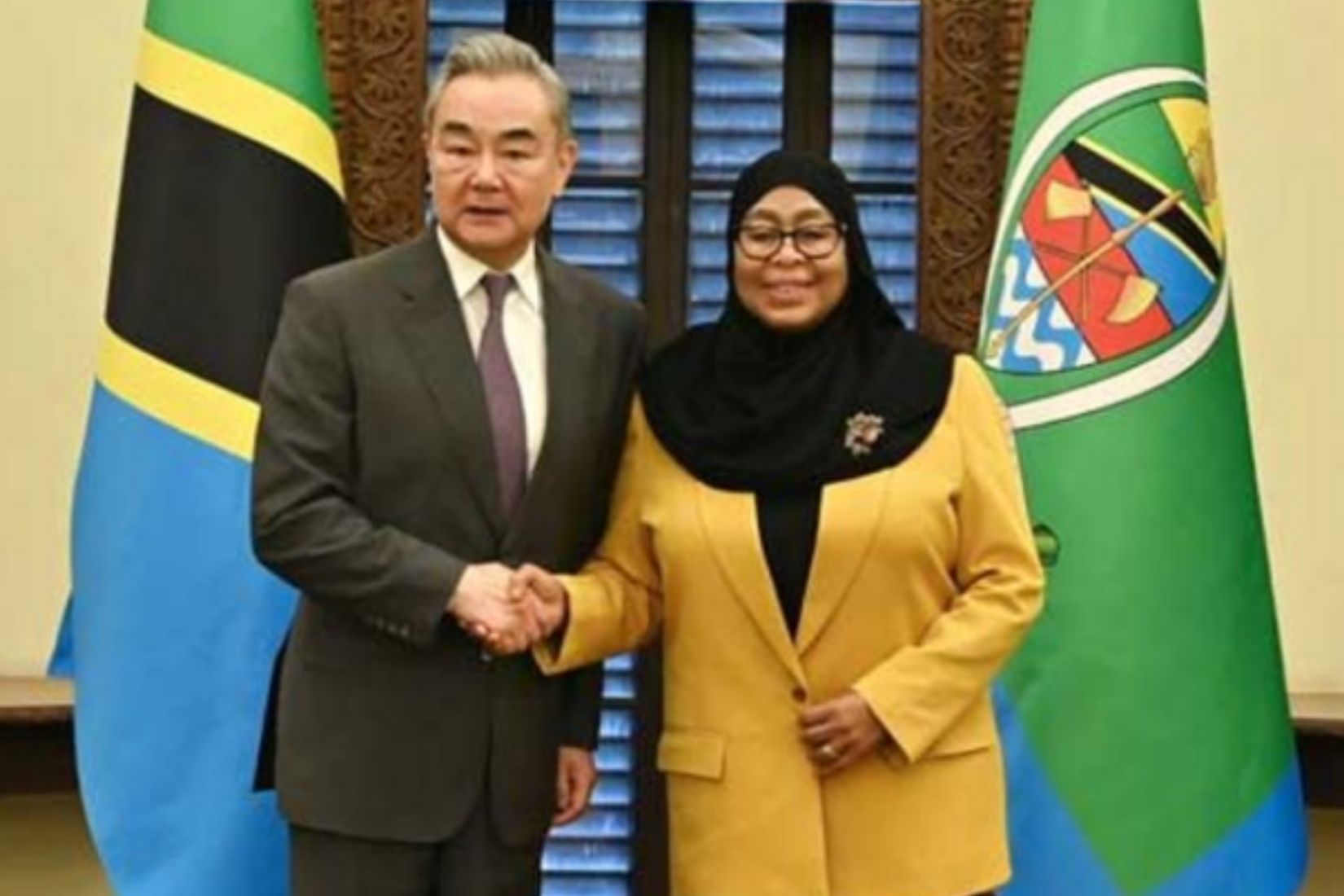
On Saturday, January 10, 2026, at State House in Dar es Salaam, President Samia Suluhu Hassan met China’s Foreign Minister Wang Yi. Smiles, handshakes, cameras, communiqués. The whole theatre of respectability.
But for many Tanzanians and many Africans watching this moment through the lens of recent repression, it did not look like diplomacy. It looked like a verdict.
It looked like the lethal handshake.
Because the lethal handshake is not only what two officials do with their palms. It is what great powers do with their silence. It is the moment global legitimacy is handed to a ruler first, and the people are remembered later, if they are remembered at all.
And that is the uncomfortable truth about China’s posture in Africa: a “non interference” doctrine that presents itself as neutral, while functioning as protection for the powerful.
The lethal handshake is not neutral, it is political
China’s foreign policy often repeats one sacred phrase: non interference in internal affairs. It is framed as principle, as restraint, even as respect.
Here is the problem. In the real world, non interference is never neutral when a state is accused of brutalizing its citizens.
When a government faces serious allegations of election violence, unlawful killings, mass arrests, enforced disappearances, and the shrinking of civic space, choosing to “just do business” is not a clean hands off posture. It becomes a decision to keep the machinery of power running anyway.
That is why the handshake becomes lethal.
Not because a handshake fires a bullet, but because it tells the security state it can keep its grip and still receive global investment, global visits, and global warmth.
Tanzania: the handshake that says power comes first
In Tanzania’s case, the context is heavy. International reporting and human rights organizations have described a post election crackdown following the October 29, 2025 elections, including large scale killings and widespread abuses. Whether one agrees with every framing or not, the public record is clear on one point: the period was marked by intense repression. The police turned their guns on citizens.
So when Wang Yi sits with President Samia at State House, the image does not land in a vacuum. It lands in a moment where state legitimacy is contested by the blood price paid by ordinary people, and by a political environment that many watchdogs describe as tightening.
And this is the core argument: China does not have to endorse abuses in words. The lethal handshake does it in symbols.
America’s imperial mask does not make China innocent
Some Africans have learned, painfully, that American and European pressure can be selective, hypocritical, and interest driven. Fine. That critique stands.
But here is the trap: disappointment in Western hypocrisy becomes the gateway drug to excusing Beijing.
China’s approach often feels smoother, less preachy, more “respectful.” Yet the underlying logic can still be imperial in outcome: strategic assets secured, influence expanded, elites stabilized, people treated as background noise.
That is why “America is bad” is not an argument for “China is good.” It is an argument for Africans to stop being played by any external power that profits from elite impunity.
Because the lethal handshake can wear a Western suit or a Chinese suit. The hand remains lethal when it prioritizes presidents over citizens.
Equatorial Guinea and the autocracy made bankable
If you want another case of “autocracy legitimized by business,” look at Equatorial Guinea under Teodoro Obiang Nguema Mbasogo, widely described by governance and rights monitors as presiding over a deeply repressive political order.
China’s footprint in Equatorial Guinea has been closely tied to large infrastructure and financing relationships over many years. The pattern is familiar: big ticket projects, major financing, and a ruler who becomes internationally “bankable” even while political freedoms remain heavily constrained.
Again, notice what this does politically.
Repressive governance does not disappear because a road is built. Repression gets a modern skyline to stand behind. Elite control gets new tools. And the ruler gets the most valuable currency of all: the appearance of being a normal partner in the international order.
That is a lethal handshake in slow motion.
The boomerang: why this strategy backfires on China in the long run
China’s defenders argue that projects are projects and sovereignty is sovereignty. But legitimacy is not a technicality. It shapes how people interpret every bridge, port, railway, and loan agreement.
Here is what China risks by normalizing the lethal handshake:
1) Deepening resentment among citizens:
When people watch their government repress them, and then watch Beijing reward that same government with elevated diplomacy, the resentment sticks to the Chinese flag, not just the local ruler.
2) Instability that threatens China’s own investments:
Authoritarian “stability” is often calm on the surface and fire underneath. Repression creates delayed explosions: protests, sabotage, ruptures, sudden leadership crises. These are terrible conditions for long term returns.
3) A reputation trap: China becomes the patron of strongmen
Beijing wants to be seen as a partner of development. The lethal handshake turns it into something else: a guarantor of impunity. That brand is radioactive in a continent where youth politics is rising and patience is collapsing.
Africa’s response: reject the lethal handshake logic
Africans do not need to choose between Washington and Beijing. Africans need to choose Africa.
We need a foreign policy culture that demands one hard rule from every outside power: people matter.
Not as a slogan. As a condition.
No leader should be able to sell their legitimacy abroad while their citizens pay the bill at home. No investor should get to pretend “non interference” is moral when it is simply profitable silence. And no African state should accept development that comes packaged with the quiet normalization of repression.
Because every time it happens, the message is sent again:
The lethal handshake. The lethal handshake. The lethal handshake.
And the cost is always paid by ordinary people.