









On December 9th 2025, the people of Tanzania spoke more powerfully than the government expected. They did not need large crowds or dramatic clashes to express disapproval. Their message came through a national shutdown so complete that it turned entire cities into ghostly spaces. They refused to pretend that the country is headed in the right direction. They refused to legitimize the administration that remains in the driver’s seat. Tanzania’s Independence Day became a day of civic defiance rather than celebration.
A man filming empty streets in Dar es Salaam captured the mood with raw clarity. “We are locked inside like rats,” he said, pointing to deserted roads and shuttered shops. His voice revealed the exhaustion of living under a state that uses fear as a governing principle. The government had outlawed Independence Day demonstrations and ordered millions to stay indoors. As officers patrolled the streets, the silence of the people became a political statement.
In Mwanza, a courageous young man addressed a small crowd that had gathered despite soldiers pacing in their midst. He stated openly that they do not recognize Samia Suluhu’s presidency. A soldier walked up to him and gently took the megaphone away. There were no blows or gunshots like those witnessed on October 29th when police used lethal force. This moment of restraint seemed to confirm a widespread feeling that the army is on the people’s side.
As all this was unfolding, the Government spokesmen declared that “there are no protests anywhere and the country is calm.” This claim collapsed under the weight of reality. From Dar es Salaam to Arusha, from Mbeya to Mwanza, small but determined protests took place. In Mbeya, a city still grieving after the post-election massacre, a small group sang the national anthem as they held banners that read “Samia must go. Free Tz” and “Uchaguzi urudiwe,” meaning elections must be repeated. In these brave acts, Tanzania’s democracy revealed its heartbeat.
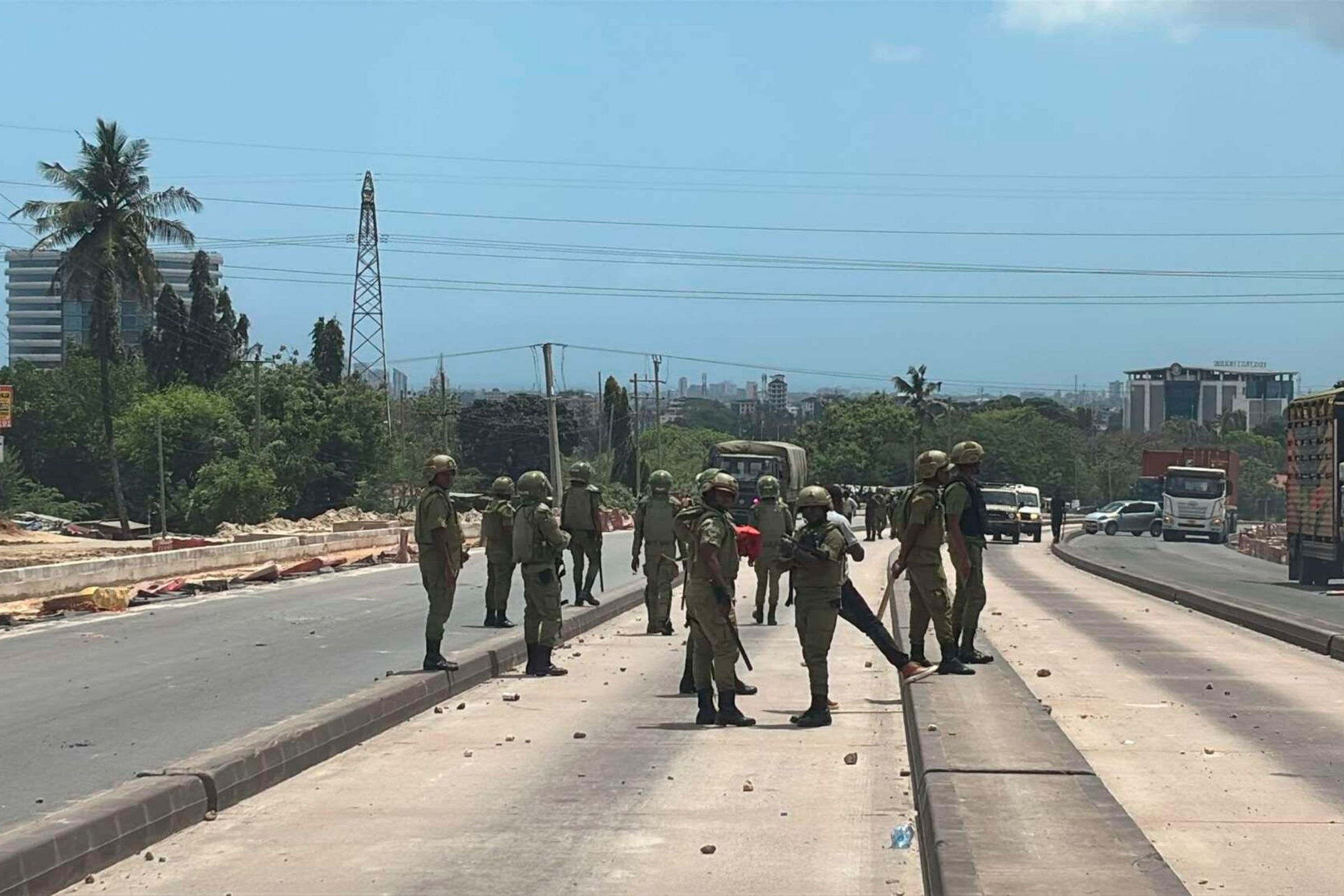
Security vehicles moved along major intersections. Officers took positions near public facilities. Roadblocks restricted movement in major cities. The government did not declare a state of emergency. Instead, it imposed a curfew without naming it, hoping the population would comply out of fear. There is no constitutional basis for this measure. Article 17 of the Tanzanian Constitution guarantees freedom of movement. Articles 12 through 20 guarantee dignity, equality before the law, the right to life, personal liberty, expression, and peaceful assembly. None of these rights can be suspended without due process anchored in law and a formal declaration of emergency. No such declaration exists.
Tanzania’s international obligations are equally clear. The African Charter on Human and Peoples’ Rights protects liberty, movement, dignity, and life. The International Covenant on Civil and Political Rights protects freedom of expression and peaceful assembly. These rights can be limited only when restrictions are lawful, necessary, proportionate, and non-discriminatory. None of these conditions are being met. The current restrictions were not crafted to protect civilians from any real threat. They were designed to shield the government from its own population.
This de facto curfew is unfolding in the aftermath of a disputed election, widespread killings, and mass arrests. It is impossible to separate these events. The message is consistent. After the post-election massacre, the state seeks to close every door through which citizens might express dissent. Peaceful protest is a right, not a privilege. Movement is a right, not a privilege. Political participation is a right, not a privilege. Tanzania is therefore experiencing a serious and unlawful suspension of civil liberties.
Human Rights Watch has documented a disturbing pattern leading up to December 9th. Activists were arrested ahead of the protests. Some disappeared for days before the police admitted that they were in custody. Ambrose Leonce Dede was seized for allegedly organizing protests through a WhatsApp group. Hospital worker Kibaba Furaha Michael was taken because he had encouraged fellow medics to participate. Teacher Clemence Mwandambo was arrested for posting online criticism. The crackdown reached deep into digital spaces. Phones and laptops were confiscated. Social media accounts were restricted after requests from the state. Even the United States embassy warned its citizens that security forces were searching electronic devices for politically sensitive content.
Opposition party members have faced some of the harshest repression. Victoria Swebe, the Chadema district chairperson in Kyela, was detained together with others. Several activists were abducted by unidentified men who claimed to be police officers. Others were arrested without charge. This pattern of intimidation has increased fears of extrajudicial actions by state agencies or groups acting on their behalf. Reports of enforced disappearances and arbitrary detentions continue to mount, while international bodies have raised alarm about the trajectory of the country.
In response to mounting pressure, the government announced the formation of an investigative commission to probe post-election violence. However, this commission consists entirely of former state officials and retired civil servants. It excludes civil society and avoids any participation by the political opposition. Its composition raises doubts about its independence. When the president asks the commission to find out who paid “those young people who took to the streets to demand rights,” the process becomes compromised from the outset.
Tanzania stands at a dangerous crossroads. The nation’s post-independence history shows that stability cannot come from silencing millions. It cannot come from inventing enemies or criminalizing dissent. Stability can only be built on justice. Accountability. Free political participation. Respect for the dignity of the human person. These values are not foreign imports. They were at the heart of Tanzania’s founding vision. They were central to the hopes of the people who celebrated independence in 1961. They are the same values citizens defended with both their silence and demonstrations on December 9th.
What happened on D9 was not a failure of citizens to protest. It was a failure of the government to listen. A government that celebrates empty streets as a victory has misunderstood the moment. The silence of the people was not compliance. It was resistance. It was political speech. It was a verdict.
The African Union, the East African Community, the South African Development Community, the African Commission on Human and Peoples’ Rights, and regional bodies must speak with clarity. Tanzania’s current trajectory threatens to erode long-standing democratic norms in East Africa. These bodies have both the moral authority and the legal duty to urge the government to respect its obligations. International actors must amplify the voices of victims and survivors. They must support a credible, rights-focused inquiry into the killings, disappearances, and mass arrests.
For the people of Tanzania, the struggle continues. Their courage is visible. Their determination is undeniable. They have shown that even under repression, they can find ways to speak. Some spoke through banners. Some spoke through megaphones even as soldiers watched them. Others spoke by staying indoors and refusing to interact with a government that has refused to secure their lives.
Independence Day was meant to mark freedom. Instead, the people used it to demand freedom. Their message is clear. The country cannot move forward without truth, without justice, without accountability, and without respect for the rights of all citizens.
December 9th 2025 will be remembered not for official speeches or cancelled ceremonies, but for the people’s voice that roared across a nation hungry for freedom and determined to reclaim its future.