







There is a lazy story we have been trained to repeat.
That Italy lost Ethiopia because “the Allies” arrived, waved a flag, and the occupation collapsed like a cheap tent in a storm.
But when you pull the curtain back, you see something far more powerful and far more African.
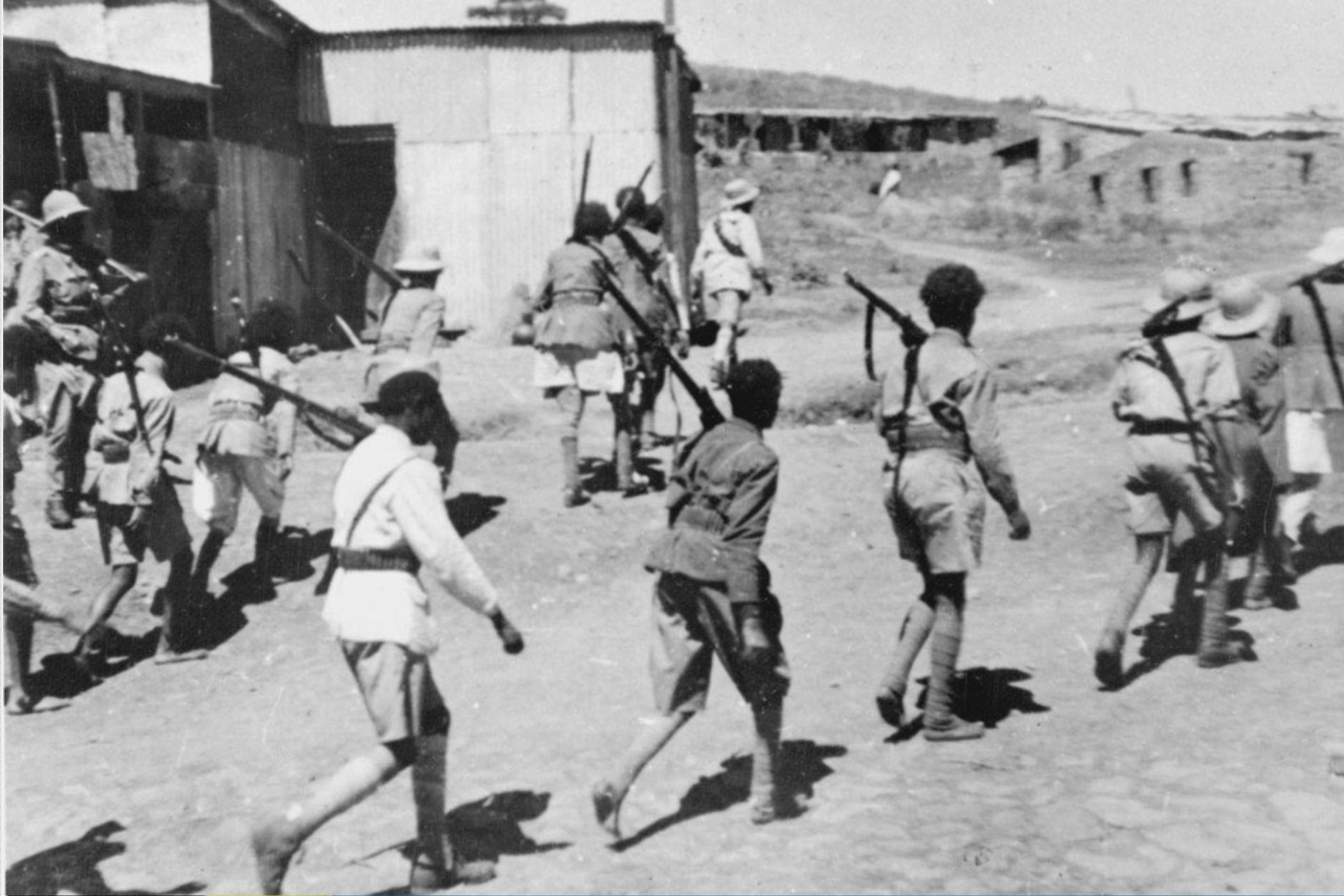
You see an army that was pan-African in its bloodstream. East Africans. West Africans. Ethiopians. Sudanese. Africans moving across African geography, fighting on African soil, cracking open the myth of European invincibility one garrison at a time.
Not as a slogan.
As a fact.
The liberation surge begins in January 1941, far from Ethiopia’s capital, in the hard borderlands of northern Kenya’s Northern Frontier District.
On 24 January 1941, the southern offensive lunges into Italian Somaliland, driving toward the Juba River line in Jubaland. From the Wajir–Liboi axis alone, the troops are staring down roughly 700+ kilometres just to reach the Kismayo area, before the real chase even begins.
Then the tempo spikes. Afmadu falls on 11 February. Kismayo falls on 14 February. And on 25 February 1941, the advance surges up the coast and seizes Mogadishu, ripping the crown jewel out of Italy’s Somali hold. From there, the column pivots inland, climbing toward the Ogaden and the Ethiopian highlands, swallowing distance with frightening speed until, in early April 1941, the road finally leads to Addis Ababa. On 6th April, the occupied capital falls back into Ethiopian hands.
Several battalions of the King’s African Rifles formed parts of the 11th and 12th African Divisions driving this offensive. What followed was the kind of momentum empires fear most: a “remarkable advance” of 1,725 miles in 53 days. Italy had held Addis Ababa for almost five years. Italian forces entered the city on 5 May 1936, turning Ethiopia’s seat of power into the showpiece of “Italian East Africa.” On 5 May 1941, Emperor Haile Selassie re-entered Addis Ababa exactly five years after the occupation began. The African infantry in the King’s African Rifles played a decisive role in defeating the Italians.
The occupation that tried to break Ethiopia’s spirit
Italy’s second war against Ethiopia ended in occupation in 1936. But occupation is not the same thing as conquest. Ethiopia never stopped resisting. Patriot networks, local commanders, and communities kept the fight alive across mountains, roads, and rural strongholds.
Those patriots have a name that deserves to be spoken with respect: the Arbegnoch, the Patriots.
When the wider Second World War ignited, Italy’s empire in East Africa became exposed. And when the counteroffensive came, it did not come as one neat European column. It came as a pressure system, squeezing from multiple directions, collapsing Italian confidence, isolating outposts, and forcing retreats.
The key is this: the campaign’s muscle was African.
Meet the spine of the campaign: the King’s African Rifles
The King’s African Rifles, the KAR, was a regiment raised across Britain’s East African territories, with African enlisted ranks and largely British officers at the time. In this war, its ranks were drawn largely from Kenya, Uganda, Tanganyika (today’s Tanzania), and Nyasaland (today’s Malawi). By the Second World War it expanded rapidly and became the trained nucleus for new East African formations.
If you want the blunt truth, here it is.
Empires loved African soldiers when it was time to march. They trusted African endurance when it was time to patrol. They relied on African discipline when it was time to hold a road, clear a town, or pursue a retreating enemy through heat and dust.
So when the liberation push into Ethiopia accelerated in 1941, the KAR did not play a decorative role. It provided the infantry backbone.
An order-of-battle snapshot for the 11th (African) Division shows KAR battalions embedded directly inside the East African brigades. For example, the 21st (East Africa) Infantry Brigade included 1st/2nd and 1st/4th battalions of the King’s African Rifles, supported by East African artillery, engineers, and services.
This matters because it destroys the myth that Africans were “auxiliaries” in someone else’s war. In this theatre, Africans were the engine that made movement possible.
The part history often mumbles: West Africans were in the same formation
The part history often mumbles: West Africans were in the same formation.
Now let’s widen the frame, because “pan-African” is not poetry here. It’s logistics. It’s unit structures. It’s who stood beside whom. That same 11th (African) Division order-of-battle lists the 23rd (Nigerian) Infantry Brigade under the division, with battalions of the Nigeria Regiment, plus West African artillery, engineers, and medical support.
And the West African footprint did not stop there. The 12th (African) Division also carried a West African spine, with a Gold Coast (today’s Ghana) brigade among its key formations, meaning Ghanaian soldiers marched in the same liberation machinery that drove toward Ethiopia.
So the liberation push was not “East Africa plus Ethiopia.”
It was East Africa and West Africa inside the same operational machine.
And this is not a small detail. It is a major African memory.
Because it meant Africans from different regions, with different languages, different food, different rhythms of life, still shared one theatre, one objective, one push through the same dust.
In short, Italy was not only being beaten by an “Allied” force in the abstract.
Italy was being beaten by Africans in formation.
.The lightning road: Kismayo, Mogadishu, Jijiga, then inland
Look at the campaign’s rhythm and you will see what African formations achieved when concentrated.
The southern front surged through Italian Somaliland. Operations moved fast: Kismayo was captured, then Mogadishu fell, and the advance chased retreating Italian forces toward the Ogaden and the Ethiopian interior. Consequently, Mogadishu was occupied on 25 February 1941. By 17 March the 11th (African) Division completed a 17-day dash along the Italian “Imperial Road” from Mogadishu to Jijiga.
That dash is not just a military statistic.
It is a political statement written in boots.
It meant Italy’s aura of permanence was breaking. It meant a fascist empire that loved pageantry was now running.
And when Addis Ababa fell fully on 3 April 1941, that “remarkable advance” of 1,725 miles in 53 days had already become legend.
Let me say it plainly.
You do not cover 1,725 miles in 53 days in hostile territory unless your infantry can endure, your supply lines can breathe, and your formations can keep cohesion under pressure.
That is what the KAR and East African formations provided.
The other half of the war: Ethiopian Patriots and the art of making an empire feel surrounded
But a liberation is never only about the big road and the headline capital.
Italy did not simply “lose battles.” It lost confidence in its ability to control the country.
And that is where Ethiopian Patriots, together with irregular formations linked to the Allied effort, became a strategic weapon.
Gideon Force, for example, is described as a British and African special force that operated as a corps d’élite alongside the Sudan Defence Force, Ethiopian regular forces, and the Arbegnoch. Its role was irregular warfare against the occupation and it operated in difficult terrain, helping eject Italian forces in western Ethiopia.
Here is the deeper truth: regular divisions can seize cities, but patriots can make an occupation ungovernable.
They can cut the illusion of control.
They can make every road feel unsafe, every outpost feel isolated, every collaboration feel temporary.
That pressure, combined with the fast-moving African divisions, is what turns a retreat into a collapse.
So when you hear “the Allies helped Ethiopia,” understand what that sentence hides.
It hides Ethiopian resistance as a living force, not a footnote.
A pan-African argument, not a pan-African fantasy
Now let me address the honest tension, because we do not build African pride on denial.
Yes, these African formations were operating inside British imperial command structures. Yes, the empire had its interests.
But here is the thing Africans must stop doing.
We must stop surrendering our own history just because it contains contradictions.
A colonized man can still fight with courage. An African soldier can still demonstrate African capacity even when the flag above the paperwork is not African.
And the campaign itself shows the pan-African reality in black and white.
The KAR were integral to the offensive into Italian Somaliland and the advance to Addis Ababa.
The 11th and 12th African Divisions were built with East African troops and West African brigades, with South African elements also present in the theatre.
The campaign involved Ethiopian Patriots (Arbegnochs) and Ethiopian regular forces in concert with African and Allied units.
So when I say “a Pan-African Army defeated Italy in Ethiopia,” I am not claiming there was a single uniform with “Pan-African” stitched on the shoulder.
I am making a sharper claim.
Africans from multiple regions, together with Ethiopians fighting for their own liberation, formed the decisive human mass that broke Italy’s hold. And they did it on African terrain, through African endurance, at African speed.
Why this victory still matters right now
Because Ethiopia 1941 carries three lessons that are still electric today.
First, unity does not need perfection to be effective. It needs alignment. East Africans, West Africans and Southern Africans did not share the same immediate colonial experience, but they shared a theatre and a target. They moved as one operational force.
Second, resistance is not always a single dramatic battle. Sometimes it is years of refusal, then one opening, then a final surge. The Ethiopian Patriots did not appear in 1941 out of nowhere. They were already there.
Third, empire collapses fastest when it cannot move safely. The dash from Mogadishu to Jijiga, the capture of key towns, the acceleration toward Addis Ababa, all of it shows what happens when momentum becomes unstoppable.
Here is the Pan-African conclusion I want to plant like a flag.
Italy’s defeat in Ethiopia was not just Ethiopia’s story.
It was an African story and an African rehearsal.
A rehearsal for what Africans could do when concentrated, coordinated, and convinced of their own power.
And if an African capital could be reclaimed in 1941 through a coalition of African bodies and African courage, then every African generation should ask itself a powerful question.
What could we reclaim today, if we treated African military unity as a strategy, not a slogan?