










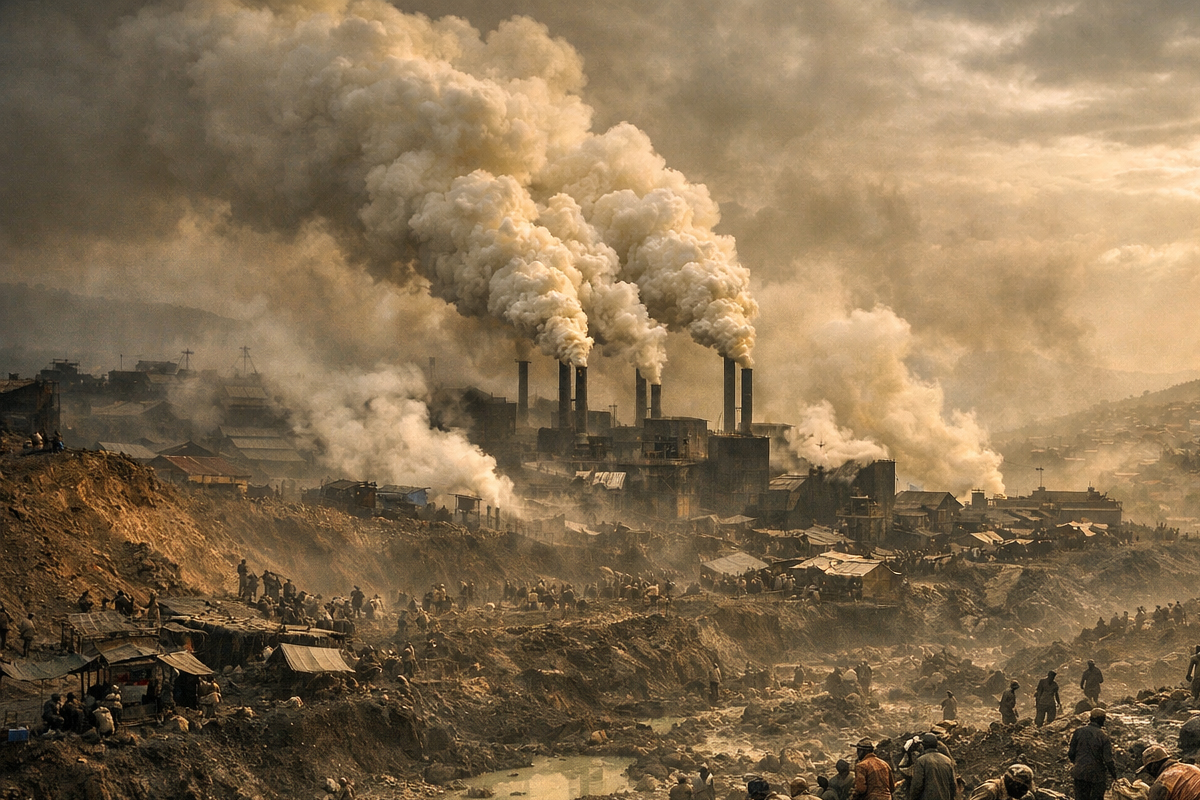
For years, the world has looked at Congo and seen war. It has seen M23. It has seen militias. It has seen chaos in the east and, from a comfortable distance, concluded that violence in Congo mostly arrives with a gun. But in Lualaba Province, another violence has been unfolding with far less attention and, perhaps, even greater impunity. It does not march in fatigues. It does not issue communiqués. It does not seize towns. It enters the body through the air. It burns the lungs. It forces blood out of mouths and noses. It leaves families terrified and children exposed. And it has been allowed to happen in one of the most strategic mineral zones on earth.
This is the other Congo story. The one hidden inside the global battery economy. The one buried beneath electric-car optimism, green-transition branding and the clean moral self-image of wealthy consumers. In mining communities around Fungurume, residents and health workers have described a nightmare of coughing blood, vomiting blood, nosebleeds, chest pain and persistent respiratory suffering associated with sulfur-dioxide emissions from cobalt-processing operations tied to CMOC, the Chinese mining giant that has become the world’s largest cobalt producer.
That fact alone should stop the world cold.
Because this is not some obscure, marginal mine operating at the edge of global relevance. This is one of the central arteries of the modern energy transition. The cobalt extracted and processed there does not sit in a Congolese warehouse. It moves. It enters the supply chains of the technologies that define modern life. Smartphones. Laptops. Tablets. Smartwatches. Power banks. Electric vehicles. What looks like sleek innovation on one end of the chain can look like poisoned air on the other.
And this is where the language of global progress begins to sound fraudulent.
For what exactly is green about a future in which cleaner transport for the world is built on dirtier air for African communities? What exactly is ethical about a transition that boasts of cutting emissions in Europe, Asia and North America while tolerating the release of toxic industrial gases over Congolese neighborhoods? What kind of moral arithmetic allows the world to celebrate decarbonization while Congolese families inhale the hidden cost of that celebration?
The answer is ugly but familiar: African suffering becomes acceptable when it is useful.
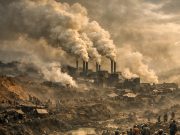
The investigation that brought renewed attention to this crisis did not describe vague discomfort or speculative anxieties. It described patterns of illness serious enough to rip apart the sanitized language of corporate sustainability. Residents living near the mine and processing areas reported symptoms consistent with exposure to sulfur dioxide. Health records showed alarming respiratory trends. Independent monitoring raised serious questions about air quality around the site. This was not merely about nuisance pollution. This was about human beings living amid signs of industrial poisoning.
And yet the most important political question is not whether the evidence is disturbing. It plainly is. The real question is this: who allowed this?
CMOC deserves scrutiny. Serious scrutiny. No serious moral argument can excuse a company that profits enormously from Congolese cobalt while communities around its operations report severe respiratory suffering. But if we stop at condemning CMOC alone, we let the Congolese state escape from the center of the story. That would be a mistake. These mines are not in China. They are in Congo. The air being polluted is Congolese air. The bodies absorbing the damage are Congolese bodies. The territory under whose sovereignty this is happening is Congolese territory.
Which means that the first line of political responsibility is not in Beijing, Brussels or Wolfsburg. It is in Kinshasa.
Congo’s government cannot hide behind the nationality of the company. It cannot pretend to be a helpless witness while one of the world’s most lucrative mineral economies corrodes the health of its own people. It cannot speak the language of sovereignty when negotiating mineral wealth and then suddenly become powerless when it is time to protect Congolese lungs, Congolese children and Congolese families.
The Constitution of the Democratic Republic of Congo leaves no room for such cowardice. It obliges the state to protect life and physical integrity. It recognizes the right to security. It guarantees the right to a healthy environment. It treats toxic pollution not as a regrettable inconvenience but as something that can trigger legal responsibility, compensation and sanction. The President is not a ceremonial bystander in this framework. The presidency is constitutionally tied to the protection of territorial integrity, security and state order. The Government is not a decorative institution either. It is constitutionally charged with defense and security functions and with the practical machinery of the state.
So when a company makes billions from Congolese minerals while nearby communities reportedly cough blood, the constitutional issue is not abstract. It is immediate. It is brutal. It is damning.
This is not merely an environmental scandal. It is a governance scandal. A sovereignty scandal. A constitutional scandal.
And Congo’s presidency and legislature should be rebuked in the strongest terms.
Because what does it say about a state when its people can be poisoned in the shadow of globally strategic mines and still the political class carries on as though the true meaning of public office is the licensing of extraction rather than the defense of human life? What does it say about a legislature when the law exists, the Constitution exists, the suffering exists, the evidence exists and yet impunity remains the most stable output of the state? What does it say about a presidency when foreign corporations can behave as though Congolese communities are expendable buffers around industrial assets?
It says the state has become too comfortable with the humiliation of its own people.
And that humiliation is made worse by the silence, weakness or complicity of those entrusted with power. Congo’s rulers want the revenues, the strategic partnerships, the status of being central to the future of electric mobility. But a government that cannot convert mineral centrality into human protection is not governing. It is merely leasing out a nation while its citizens absorb the damage.
Let us say something else plainly, because diplomacy too often softens truths that should be spoken with force: there is no serious reason to believe that the Chinese state would calmly tolerate a major industrial facility sending nearby Chinese communities into waves of nosebleeds, respiratory distress and blood-coughing without fierce state intervention, regulatory escalation and public alarm. China may defend its commercial interests abroad, but within its own borders it understands power. It understands control. It understands the political danger of allowing strategic industry to openly brutalize the population it governs.
Why then should Congolese lives be treated more cheaply in Congo than Chinese lives would be treated in China?
That question should haunt every official in Kinshasa.
Because this is where the colonial pattern mutates into a modern form. Africa is told it is participating in the industries of the future. It is told it is indispensable to global transformation. It is told its cobalt, lithium, copper and rare minerals will place it at the heart of a new economic age. But too often what this really means is that African soil remains strategic while African people remain disposable. The minerals are precious. The communities are negotiable. The exports are protected. The citizens are not.
That is not partnership. That is not development. That is not green transition. That is organized hypocrisy.
And Congo’s government must not be permitted to dress this hypocrisy in the language of national progress. A state does not become visionary because foreign investors are active on its soil. A state becomes worthy when its people can breathe without fear. When parents do not watch children bleed from the nose because a mine is productive. When the old are not left to inhale poison in the name of global sustainability. When the Constitution is not just recited during political ceremonies but enforced against those who violate its spirit and its command.
The tragedy of Congo is that its people suffer not only from predators, but from permissions. So much harm in Africa does not happen because governments are absent. It happens because governments are present in all the wrong ways: present to sign, present to negotiate, present to pose, present to extract rents, present to celebrate investment, but absent when it is time to protect the vulnerable from the cost of those deals.
That is why the primary enemy in this story is not only the emitting company. It is the political order that permits the emissions, normalizes the suffering and then behaves as though accountability is an inconvenience. A foreign company may pollute. But only a weak, compromised or indifferent state allows such pollution to settle into the lives of its people as a routine condition of national development.
And there is a final insult buried inside all this.
The world will likely continue marketing electric vehicles as symbols of conscience. Governments will continue speaking the language of clean energy. Corporations will continue publishing ESG reports. Consumers will continue charging devices with little thought about what made that convenience possible. Meanwhile, in Congo, families near the mines are left to bear the price in their lungs, their blood, their fear and their uncertainty.
So this is the green transition?
Electric cars for the world. Toxic air for Congo.
Africa should reject this arrangement with moral clarity and political rage. Congo’s citizens should reject it with constitutional insistence. The country’s judiciary, civil society, lawmakers and communities should force this crisis into the center of national life until it can no longer be managed as a peripheral inconvenience. Because a Constitution that cannot protect citizens from poisoning in the heart of a strategic industry is not being upheld. It is being mocked.
And a government that allows this mockery to continue deserves not praise for attracting investment, but condemnation for failing its most basic duty.
Congo does not lack a constitutional mandate. It lacks a ruling class willing to honor it.
That is the scandal.
That is the shame.
And that is the truth the world must stop looking away from.
Sources
Constitution of the Democratic Republic of the Congo. 2006. English translation. Accessed March 16, 2026.
Environmental Investigation Agency. Toxic Transition: How CMOC’s Cobalt Expansion Has Poisoned Communities in the Democratic Republic of Congo. London: Environmental Investigation Agency, March 2026.
Environmental Investigation Agency. “Report: Cobalt Mine Supplying Major Western Automakers Has Triggered Public Health Crisis in Democratic Republic of Congo.” Press release, March 9, 2026.
CMOC Group Limited. “CMOC Releases 2024 Annual Results.” March 24, 2025.
Cobalt Institute. Cobalt Market Report 2024. London: Cobalt Institute, 2025.
The Wall Street Journal. “Investigators Say Chinese Cobalt Plant Sickened Congo Town.” March 10, 2026.