














There is a pattern in Congo’s modern wars that keeps repeating like a bad chorus. When the national army looks tired, when commanders panic, when allies bargain, Kinshasa reaches for a familiar shortcut: white mercenaries. They arrive with new accents, new passports, and the same old promise. “We can fix this.”
Then Congo pays the bill twice. First in dollars. Then in sovereignty.
When Stanleyville Learned the Word “Mercenary”
In the early 1960s, the new Congo came apart at the seams and Katanga’s secession turned the country into a magnet for soldiers of fortune. Foreign fighters flooded in to prop up breakaway ambitions, fight the army and protect mineral interests dressed up as ideology. Out of that chaos stepped names that later became their own genre: Bob Denard, who treated a mortar like a personal signature, and the wider cast that history remembers as “Les Affreux,” the terrifying ones.
By 1964, mercenary units were being presented as a “last resort” for a demoralized army. The Fifth Brigade was born as an all-white formation, mobile commando teams, fast logistics, modern kit, American rations, regular pay, and planes delivering fresh supplies. It looked like efficiency. It felt like competence. It also taught a lethal lesson: when outsiders win your battles, your own army stops learning how.
Kisangani: The Mutiny That Exposed the Deal
Kisangani, once Stanleyville, did not just witness mercenaries. It watched them turn their guns from rebels to politics. Jean Schramme and Bob Denard became central figures in the mercenary rebellion drama of the late 1960s, the moment when the soldier-for-hire stopped pretending to be a tool and started acting like a political actor.
That is the hidden cost of mercenarism. It does not only fight your enemy. It enters your command chain, your bargaining table, your succession anxieties. It becomes a faction.
Michael Hoare and the Myth of the “Clean Fix”
Michael Hoare’s era helped sell the myth that a disciplined foreign commander could do what a fractured state could not. The story always arrives polished: professionals, quick wins, a rescued capital, a routed rebellion. The camera loves it. So do desperate presidents.
But the myth is corrosive. It encourages leaders to treat the national army as a temporary inconvenience instead of the institution that must be rebuilt. It pushes training, welfare, logistics, and accountability to the side, right when those are the only things that can produce a real military.
1977: Africa Tries to Shut the Door
By the 1970s, the continent had seen enough coups, raids, and paid adventurism to recognise mercenarism as a political weapon aimed at young African states. In 1977 the Organization of African Unity adopted the Convention for the Elimination of Mercenarism in Africa, framing mercenarism as a preserver of colonial and racist domination and committing states to criminalize it.
The moral position was clear. The enforcement was uneven. Mercenarism did not disappear. It adapted.
Mobutu’s Final Gamble: Eastern Europe, Cheap and Unromantic
When Mobutu’s regime began collapsing in the 1990s and the First Congo War loomed like a storm, he reached again for hired firepower. This time he discovered a new market: Eastern Europeans with fewer colonial associations, often veterans of brutal Balkan battlefields, cheaper than the classic West European and white African mercenary circuit. The man put in charge of this last-ditch imported shield was Christian Tavernier, a French soldier-of-fortune who became the public face and field commander of Mobutu’s foreign recruits as Zaire slid toward the cliff.
That recruitment brought in hundreds of ex-Yugoslav fighters, associated in many accounts with a “White Legion.” Inside that force, one name keeps surfacing because he embodied the post–Cold War mercenary pipeline: Jugoslav “Yugo” Petrušić. “Yugo” was not a nickname for nostalgia, it was shorthand for origin and reputation, an ex-Yugoslav officer linked to the Balkan wars who moved through the grey zone of private security and war-for-hire networks that sprang up after Yugoslavia’s collapse. In Congo, his name appears as one of the key commanders within the Eastern European contingent that Mobutu hoped would stiffen collapsing lines. The logic was simple: buy experience fast, buy distance from history, buy time.
Time is the one thing mercenaries rarely deliver.
The New Century: From Battlefield Mercenaries to Shadow Contractors
By the time Joseph Kabila was in power, the mercenary story had modernized. The headline mercenary battalion was less visible, but the hired muscle did not vanish. Kabila recruited private intelligence contractors and irregular auxiliaries as tools for regime security. The theater changed. The instinct remained. When power feels threatened, Congo’s rulers keep outsourcing the dirty work, whether through intelligence, proxies, or deniable armed men.
The state becomes a client. The security sector becomes a marketplace.
Potra’s “Romeos” and the Goma Humiliation
Then came the era of Horațiu Potra, a Transylvanian former French legionnaire who built a private military pipeline that pulled in Romanians and other Eastern Europeans with mortgage pressure, family pressure, and the promise of a salary that dwarfed what Congolese soldiers earn.
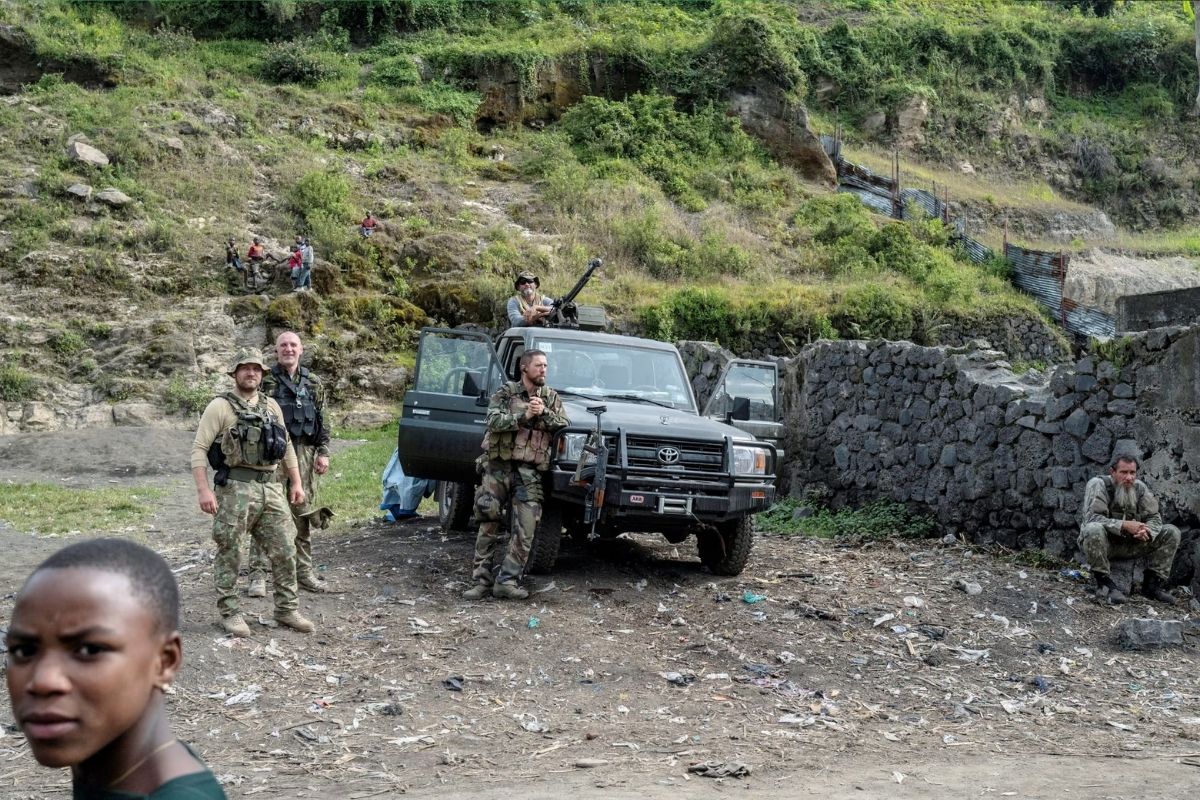
In late 2022, as M23 tightened the ring around Goma, two firms entered the scene. One was Agemira, linked to intelligence and logistics support and a wider ecosystem of foreign personnel around aircraft maintenance and flight operations. The other was Potra’s force, the bulk of the hired presence, known in security circles as “the Romeos.” At their height, the operation was said to approach a thousand men.
The pitch was “coaching.” The footage and testimony have told a harsher story: drones, quick-reaction teams, coordination of fire, heavy weapons, and combat proximity. In the same terrain where Congolese troops survive on thin pay and thinner morale, these contractors became a parallel military class with different salaries, different standards, and different incentives.
And like so many mercenary projects in Congo, it did not fail quietly. It failed on camera.
In January 2025, after a two-year siege ended with M23 and Rwandan forces taking Goma on 28 January, nearly 300 white mercenaries were lined up for a televised humiliation, escorted under UN protection toward the border and flown out. It was not only a defeat for Congo’s Army. It was a defeat for the idea that Congo can rent victory.
February 2024: The Death That Summarized the Business Model
The mercenary economy always hides behind euphemisms until a name breaks through. Vasile Badea, a former Romanian policeman on sabbatical, became one of those names when he was killed in DR Congo in February 2024, after taking the job for the money.
His story is the human underside of Potra’s pipeline. Men who are underpaid at home hear rumors of recruitment, sign short contracts, buy their own extra kit, accept the absence of medical insurance, and enter a war that does not care about their paperwork. Some are hardened veterans. Some are guards and drivers. Some arrive too old for the terrain. Then the battlefield sorts them out.
In the end, even the mercenaries called it what it was. A circus. A deadly one.
The Real Consequence: A Weaker Army and a Stronger Dependency
Mercenaries do not just fight alongside Congo’s army. They reshape it. They create salary resentment. They distort command authority. They incentivize shortcuts. They make presidents believe the hard work of reform can be postponed one more season.
Meanwhile, the enemy learns. M23 watches how quickly outsourced solutions collapse under stress. Rwanda watches how deniable foreign fighters complicate diplomacy. Local militias watch how to bargain for relevance. The mercenary becomes one more actor in Congo’s already crowded war economy.
Congo’s tragedy is not that mercenaries arrive. It is that leaders keep inviting them as if the last fifty invitations did not end the same way.
The Takeaway: The Shortcut Is the Trap
From Denard’s early wars-for-hire to Kisangani’s mutinies, from Mobutu’s Eastern European gamble to Potra’s Romeos running for the UN base in Goma, the storyline stays brutally consistent. Hired soldiers can win moments. They poison institutions.
Congo does not need another foreign “fix.” Congo needs the slow, unglamorous revolution of a real army: pay that arrives, logistics that work, discipline that holds, promotions that reward competence, and a chain of command that does not rent its confidence from strangers.
Because every time Congo outsources its survival, it trains itself to be dependent. And dependency is the one war Congo cannot afford to keep fighting.