
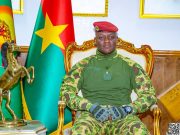
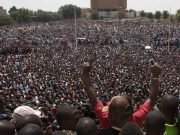
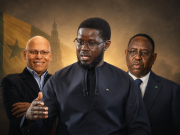

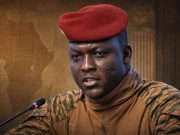






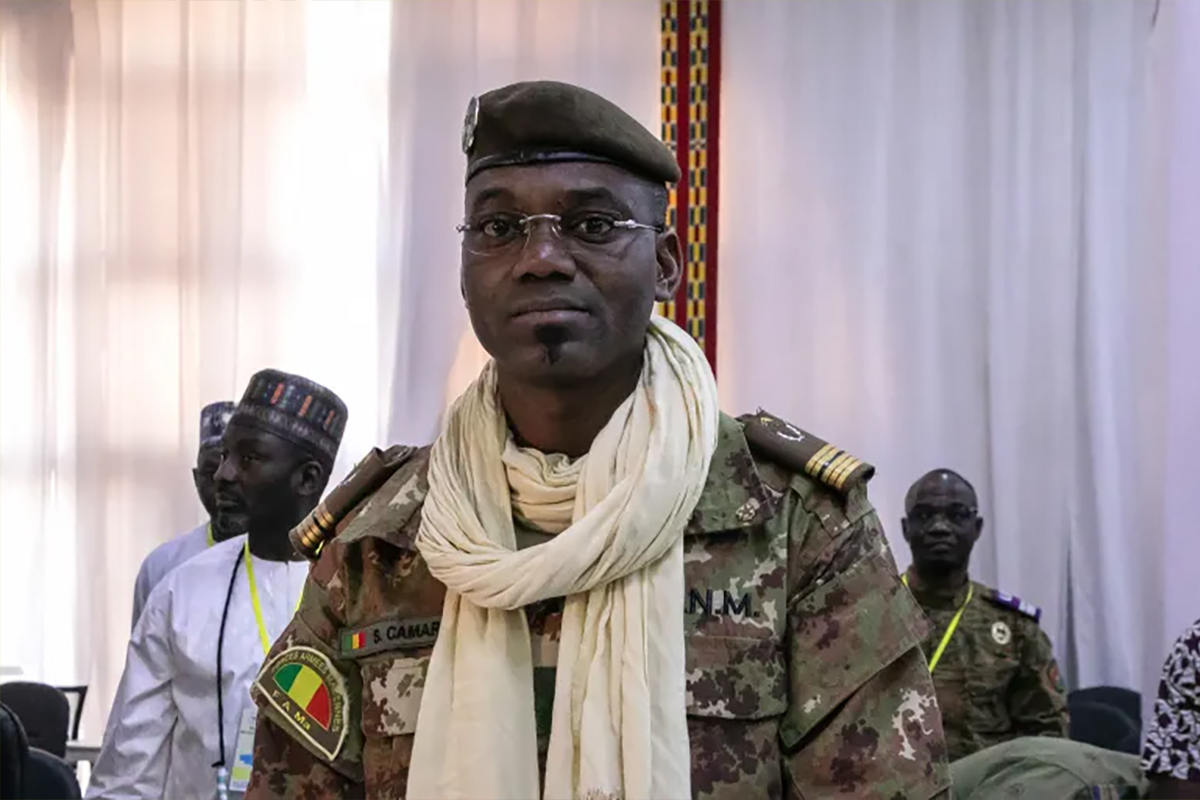
Mali is no longer facing an ordinary insurgency. It is facing a coordinated attempt to break the confidence of the state, stretch the capacity of its armed forces, and convince citizens that the government can no longer protect even its most secure spaces. The killing of Defence Minister General Sadio Camara during coordinated attacks on military sites across the country has therefore landed like a political earthquake. Camara was not a peripheral figure. He was one of the most powerful men in Mali’s military government, a central actor in the leadership that emerged after the coups of 2020 and 2021, and a symbol of the state’s hard-security posture.
What makes the reported attack even more alarming is where it happened: Kati, the heavily fortified garrison town just outside Bamako. Kati is, however, more than a military location. It is one of the nerve centres of Mali’s military establishment. It is also the town where President Assimi Goïta lives. If armed attackers linked to Jama’at Nusrat al-Islam wal-Muslimin (JNIM) and Tuareg fighters from the Azawad Liberation Front (FLA) could strike there, then the message was brutally clear: Mali’s enemies are no longer content with attacking remote bases, distant convoys, and exposed villages. They are reaching into the fortified heart of the state.
This is why Mali’s current crisis must be understood beyond the language of “another attack.” It is a struggle over power, legitimacy, sovereignty, and the future of the Sahel. To understand what is unfolding, we must look through three lenses: Ahmed al-Sharaa, Syria’s president; Assimi Goïta, Mali’s current president; and Modibo Keïta, Mali’s first president. Al-Sharaa helps us understand the danger of armed groups that begin to imagine themselves as future governments. Goïta helps us understand Mali’s present struggle for security and sovereignty. Modibo Keïta helps us understand Mali’s unfinished promise.
The Syria Playbook
Ahmed al-Sharaa was not always a president. Before becoming Syria’s transitional leader, he was a rebel commander. Before walking into presidential offices, he walked through war. He led Jabhat al-Nusra, a rebel group formerly affiliated with al-Qaeda. His rise from insurgent leader to national ruler is now a dangerous lesson for armed groups around the world.
That lesson is simple but terrifying. First, a group is called terrorist. Then it fights the state. Then the state weakens or collapses. Then the world adjusts. Then the group is no longer treated only as a militant formation. It becomes a “stakeholder,” a “transition actor,” perhaps even a “necessary partner.” This is the playbook that extremist and insurgent groups may now be studying closely.
JNIM appears to understand this psychology. Its April 25 statement did not sound like the communiqué of a small group hiding in the desert. It sounded like the language of national ambition. The group claimed attacks on the headquarters of President Assimi Goïta, operations against airports, military positions in Gao, and control or gains in places such as Mopti, Kidal, San, Sévaré, and Gao. Whether every claim is fully accurate is one matter. The political message is another.
JNIM wants Malians, Africans, and the international community to believe that the Malian state is vulnerable. It wants to prove that Bamako can be touched, that Kati can be penetrated, and that Mali’s security architecture can be stretched. Once a terrorist group starts imagining itself not simply as an insurgency but as an alternative centre of power, the conflict changes. It becomes not only a war of bullets but a war of legitimacy.
France’s Shadow Over Mali
To understand how Mali reached this point, we must revisit a 2022 letter Mali sent to the United Nations Security Council. That letter was not normal diplomatic correspondence. It was a diplomatic bomb. Mali accused France of repeatedly violating its airspace with drones, helicopters, fighter jets, and intelligence aircraft. Bamako claimed French forces switched off transponders, ignored air-traffic control, falsified flight documents, flew spy missions, harassed Malian aircraft, and conducted operations inside Mali without permission.
In plain language, Mali accused France of treating Malian skies as if Mali were still a colony.
Then came the most explosive accusation. Mali alleged that France used these illegal flights to gather intelligence for terrorist groups operating in the Sahel and even to drop arms and ammunition to them. This was not a minor allegation. A former colonial power was being accused before the United Nations of assisting the very terrorists it claimed to be fighting.
Mali also accused France of information warfare around the Gossi base, arguing that French drone images were used to tarnish the image of the Malian army. In Bamako’s framing, France was not merely guilty of poor coordination. It was accused of espionage, intimidation, subversion, destabilization, and aggression.
Yet after Mali dropped this diplomatic bomb, there was no major public investigation by the Security Council, no sanctions, no resolution against France, and no accountability process matching the seriousness of the allegations. That silence matters. Either Mali’s accusations were false and deserved to be publicly disproved, or they were true and deserved decisive international action. What was not acceptable was diplomatic indifference.
When one now looks at the scale, coordination, confidence, and ambition of JNIM’s attacks, it becomes legitimate to ask difficult questions. Where are these groups getting their intelligence? Where are they getting their weapons? Who benefits when Mali burns? These are not conspiracy questions. They are security questions. Insurgencies do not grow on slogans alone. They require supply lines, money, arms, intelligence, political openings, and chaos. When chaos becomes this organized, Africa must ask who is organizing it.
Assimi Goïta and the Limits of Slogan Sovereignty
Assimi Goïta came to power promising sovereignty, dignity, and security. He rejected the old dependency on France, turned toward Russia, and helped lead Mali into the Alliance of Sahel States alongside Burkina Faso and Niger. To many Africans, this language resonates deeply. For too long, African countries have been told that sovereignty is legitimate only when approved in Paris, Washington, Brussels, or London.
But sovereignty is not a slogan. Sovereignty must protect people. It must secure villages. It must keep roads open. It must allow farmers to farm, traders to trade, children to go to school, and citizens to sleep without fear. If a state waves the flag of sovereignty while armed groups expand, citizens will eventually ask a painful question: what kind of sovereignty is this?
This is where Mali’s present becomes complicated. Replacing France with Russia is not the same thing as building true independence. If one foreign power fails you and you simply run to another foreign power, you may have changed the flag of dependency, but not the logic of dependency. Russia’s Africa Corps may offer military assistance, but it has not ended Mali’s insecurity. It has not crushed JNIM. It has not restored peace to the Malian people.
Mali must therefore ask deeper questions. What is the security strategy beyond foreign partners? What is the political strategy beyond military operations? What is the development strategy beyond speeches? What is the governance strategy beyond anti-French anger? Anger can awaken a nation, but anger alone cannot rebuild one.
Modibo Keïta and Mali’s Unfinished Promise
This is where Modibo Keïta, Mali’s first president, becomes essential. Born on June 4, 1915, Keïta was a teacher, Pan-Africanist, and nationalist who believed that independence had to mean more than a new flag. When Mali became independent on September 22, 1960, Keïta did not merely seek symbolic sovereignty. He sought real sovereignty — political, economic, monetary, and cultural.
Keïta understood a truth that many African leaders still avoid: a country can have a president and still lack power. A nation can have an anthem and still be trapped in someone else’s system. A people can raise a flag and still be governed by structures they do not control.
That is why, in 1962, Mali left the CFA franc and created the Malian franc. This was not just an economic move. It was a declaration of dignity. Mali was saying that its money, economy, and future had to answer to Malians.
But the dream was difficult. External pressure, internal division, economic weakness, administrative fragility, and political strain made the experiment hard to sustain. Eventually, in 1984, Mali returned to the CFA zone. That return symbolized the painful truth that defiance without institutional strength is vulnerable.
This is the lesson Goïta must learn from Modibo Keïta. Courage is not enough. Anti-colonial language is not enough. Defiance is not enough. A sovereign state must build institutions strong enough to survive pressure, an economy strong enough to feed its people, an army professional enough to protect citizens, and a government trusted enough to unite the nation.
The Real Battlefield Is Trust
Yes, Mali must defend itself militarily. No serious country allows armed groups to terrorize its people. But Mali must also defeat the conditions that allow JNIM to recruit, expand, and pretend to be an alternative. The terrorist does not arrive only with a gun. Sometimes he arrives where the state has disappeared. He arrives where the school has collapsed, where the road is unsafe, where the court is corrupt, where the young man has no job, no dignity, no hope, and no one listening.
That is the real battlefield.
The battlefield is trust.
The battlefield is governance.
The battlefield is dignity.
The battlefield is whether Malians can once again believe that the republic belongs to them.
This is why Mali’s struggle matters to all of Africa. If Mali sinks deeper into this security nightmare, the shockwaves will not stop at its borders. They will move across the Sahel, threaten coastal West Africa, deepen migration, expand arms trafficking, and give terrorist groups the confidence to dream bigger.
Africa cannot allow armed groups with extremist ideologies to believe they can shoot their way into power and then wait for the world to normalize them. JNIM’s Syria dream must be crushed before it becomes a continental nightmare.
Mali Must Rise Beyond the Gun
The lesson of Ahmed al-Sharaa is that armed groups study weak states. The lesson of Assimi Goïta is that sovereignty must become security, not rhetoric. The lesson of Modibo Keïta is that independence without real control is unfinished business.
Mali is not a failed dream. It is an ancient civilization trapped in a modern security crisis. This is the land of Timbuktu, scholarship, empire, memory, music, resistance, and pride. Mali has survived empires, colonization, coups, droughts, betrayals, rebellions, and broken promises. But survival is not enough. Now Mali must transform.
That transformation will not come from Paris. It will not come from Moscow. It will not come from New York. It will not come from the United Nations Security Council. It must begin with Malians and be supported by Africans who understand that Mali’s struggle is Africa’s struggle.
Mali deserves peace. Mali deserves sovereignty. Mali deserves truth. Mali deserves leadership that learns from Modibo Keïta’s courage, avoids Modibo Keïta’s strategic mistakes, and refuses to let JNIM turn Mali into another Syria.
Wishes are not a strategy. Blaming France alone is not enough. Relying on Russia alone is not working. Military force alone cannot solve a crisis rooted in governance, exclusion, mistrust, and external interference.
Mali must expose every external actor helping armed groups. It must hold its own officials accountable where governance fails. It must build a security strategy that does not depend on foreign saviors. And Africa must stand with the Malian people — not blindly with any government, not blindly with any foreign power, but firmly with the people’s right to peace, dignity, and sovereignty.
Because when one African country is destabilized, Africa is weakened. And when one African country rises with dignity, Africa is strengthened.
Mali can rise again. But only if it confronts the enemies outside, the weaknesses inside, and the dangerous illusion that sovereignty can be achieved by slogans alone.