











Mombasa, Macron, and the return of an old question
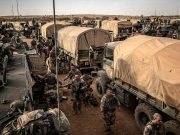
On the morning of March 15, 2026, Mombasa Harbour offered Kenya a scene that looked administrative on the surface but historical underneath. Three French warships cut into the coast. Eight hundred French troops disembarked onto Kenyan soil. They were armed. Their weapons were licensed in France. Their vehicles were registered in France. Their ammunition had been approved in France. They did not arrive as tourists or diplomats. They arrived as soldiers entering a friendly jurisdiction under a new military logic that allowed them to move with startling ease.
No customs friction. No immigration drama. No symbolic reminder that they were stepping into another sovereign republic. They passed through Kenya with the smoothness of a force moving through its own territory. Under the Kenya-France Defence Cooperation Agreement, that ease was not accidental. It was structured. It was negotiated. It was the point.
The official story was clean enough. France and Kenya were deepening cooperation in maritime security, intelligence-sharing, training, peace support operations, and counter-terrorism. Nairobi presented the moment as evidence of Kenya’s rising stature as a regional security hub. Paris could present it as the natural evolution of relations between two serious states confronting a dangerous world.
But history rarely enters a country as history. It enters dressed as policy.
And for many Kenyans watching those ships dock in Mombasa, what surfaced was not simply the language of partnership. It was memory. It was suspicion. It was the uneasy recognition that when a foreign military power is given extraordinary access on African soil, the real question is never only what the agreement says. The real question is what kind of relationship it reveals.
This is why the Kenya-France Defence Cooperation Agreement deserves far more scrutiny than the language of diplomacy has so far allowed. On paper, it is a defence pact. In practice, it may also be a geopolitical rescue mission for France, a prestige project for President William Ruto, and a fresh test of how much sovereignty Kenya is willing to negotiate away in exchange for global access, military cooperation, and elite approval.
The deal looks technical. Its implications are not.
At first glance, the agreement can seem like standard statecraft. Countries sign defence cooperation agreements all the time. They train together. They exchange intelligence. They hold joint exercises. They deepen operational ties. In a region shaped by terrorism, maritime insecurity, cyber threats, and fragile borders, such cooperation can sound not only reasonable but necessary.
Kenya, after all, has real security concerns. Al-Shabaab remains a live threat. The Indian Ocean has growing strategic importance. Nairobi wants to project itself as a security anchor in East Africa and as a trusted partner in regional and international stabilization missions. Working with a technologically advanced military power like France has obvious attractions: better training, better intelligence, better exposure, better standing.
But defence agreements are never merely about practical cooperation. They are also about hierarchy. They are about who gets exemptions, who carries the legal burden, who controls accountability, and who can move through whose territory under exceptional privilege.
Under the agreement, French military personnel may enter Kenya using official identification and movement orders rather than the standard immigration procedures that apply to ordinary entrants. Their equipment and supplies are exempt from customs duties and inspections. More strikingly, French personnel are allowed to operate vehicles, weapons, and ammunition in Kenya using licences issued in France rather than Kenya.
Governments like to call such clauses routine. And perhaps they are. But “routine” is one of those words powerful states use when they want unequal arrangements to sound boring. A clause can be common and still be dangerous. It can be familiar and still erode dignity. It can be legal and still reveal which party in a partnership has been trusted to remain fully sovereign and which party has been asked to bend.
Agnes Wanjiru and the memory Kenya cannot suppress
Every defence agreement involving foreign troops should be read not only through legal language but through human precedent. In Kenya’s case, that precedent has a name.
Agnes Wanjiru.
Her story hangs over every conversation about foreign military presence in Kenya because it reminds the country what can happen when visiting soldiers operate in a system where justice becomes delayed, diffused, or diplomatically inconvenient. Wanjiru, a young Kenyan woman, disappeared in Nanyuki, a town long associated with foreign military activity, especially British troops. Her body was later found in a septic tank. Witnesses implicated British soldiers. Yet for years, accountability remained elusive. The case only regained national and international attention after journalistic investigation dragged it back into the light.
That is not a side issue. It is the issue.
Because the deepest fear around foreign defence agreements is not that they exist. It is that they create an impunity gap. In principle, accountability is present. In practice, it is slippery, delayed, outsourced, or buried beneath diplomatic considerations. What happened in the Wanjiru case exposed how easily a Kenyan life can be trapped between public outrage and institutional paralysis when foreign military actors are involved.
So when Parliament considered a new defence pact, this time with France, it was not dealing with an abstract matter of bilateral cooperation. It was dealing with the same enduring question that Wanjiru’s death forced into Kenyan political consciousness: when a foreign military presence causes harm, whose justice system actually matters?
France’s jurisdiction, Kenya’s uncertainty
That question becomes sharper when one examines the legal structure of the deal.
The agreement gives France primary jurisdiction over offences committed by its personnel in the course of official duties, while Kenya retains jurisdiction mainly over conduct outside official duties or in narrowly defined circumstances involving Kenyan citizens. Both countries can waive jurisdiction. On paper, this can be packaged as a balanced mechanism between sovereign partners. In reality, it creates a wide zone of discretionary power for the foreign state.
And that is where sovereignty begins to wobble.
Because “official duty” is not a minor phrase. It is a protective category. It can become the legal shelter beneath which misconduct is distanced from local justice. It means the decisive question in a moment of harm may not be what Kenya wants, what Kenyan communities demand, or what the Constitution promises. The decisive question may be whether France chooses to prosecute, how France defines the conduct, and whether France decides the matter deserves full accountability at all.
For a country with one of Africa’s most progressive constitutions, that should be alarming. Kenya’s Constitution promises equality before the law, access to justice, and fair process. Yet any arrangement that effectively creates one legal pathway for citizens and another for foreign armed actors strains those promises. A republic cannot preach legal equality in theory while carving out exceptional practical protections for foreign forces.
This is what makes defence agreements so politically sensitive. Their language may sound administrative, but their consequences are constitutional.
Parliament as conveyor belt
The way the deal moved through Parliament only sharpened the discomfort.
Lawmakers passed the agreement subject to reservations. That phrase sounds sturdy until one remembers that reservations are not amendments. Parliament could signal concern. It could attach cautionary language. But it could not fundamentally rewrite the architecture of the treaty. One legislator reportedly complained that the House risked being reduced to a conveyor belt, a devastating phrase because it captures the democratic emptiness that can arise when elected representatives are allowed to observe sovereignty being negotiated more than they are allowed to shape it.
If Parliament cannot meaningfully alter agreements touching on jurisdiction, force, entry privileges, and military conduct on Kenyan soil, then ratification risks becoming performance rather than oversight. The ceremony of democracy remains. The substance grows thinner.
And this matters because defence agreements are unlike ordinary treaties. They involve organized force. They involve lethal capacity. They involve the relationship between citizens and armed foreign actors who may, under certain conditions, possess extraordinary immunities or protections. Any democratic system that treats such agreements as largely executive matters with limited parliamentary redesign power should worry every serious student of sovereignty.
Why France needs Kenya now
To understand the full significance of the Kenya-France agreement, one must leave Nairobi for a moment and look west.
Across the Sahel and wider Francophone Africa, France has suffered a strategic collapse. In Mali, France was accused of unilateralism and pushed out. In Burkina Faso, French forces were expelled as anti-French politics intensified. In Niger, Paris endured a humiliating rupture that symbolized the unravelling of its post-colonial military order. Even Senegal, once among France’s most stable and reliable partners, has ended France’s permanent military presence. The Central African Republic shifted toward alternative partners, especially Russia.
This is not a string of isolated setbacks. It is the breakdown of France’s old African security architecture.
For decades, Paris maintained a system in which military presence, elite relationships, and security partnerships helped preserve its influence long after formal colonialism ended. That model has been battered by public anger, nationalist resurgence, coups, and a widening African impatience with arrangements that smell of managed sovereignty. France needed a reset. It needed a partner that was stable, internationally respected, strategically located, and politically willing.
It found that partner in Kenya.
Kenya offers France something precious in this moment: legitimacy outside the increasingly hostile terrain of Francophone West Africa. It is English-speaking, regionally influential, economically ambitious, diplomatically connected, and central to East African security and logistics. In geopolitical terms, Kenya is not just another bilateral partner. It is a new platform. A new address. A new foothold.
That is why this agreement matters so much more to France than its dry legal title suggests. It is not simply about Kenya. It is about France rebuilding relevance on a continent where its old model is collapsing.
The Macron-Ruto alignment
This deal is also shaped by political chemistry at the top.
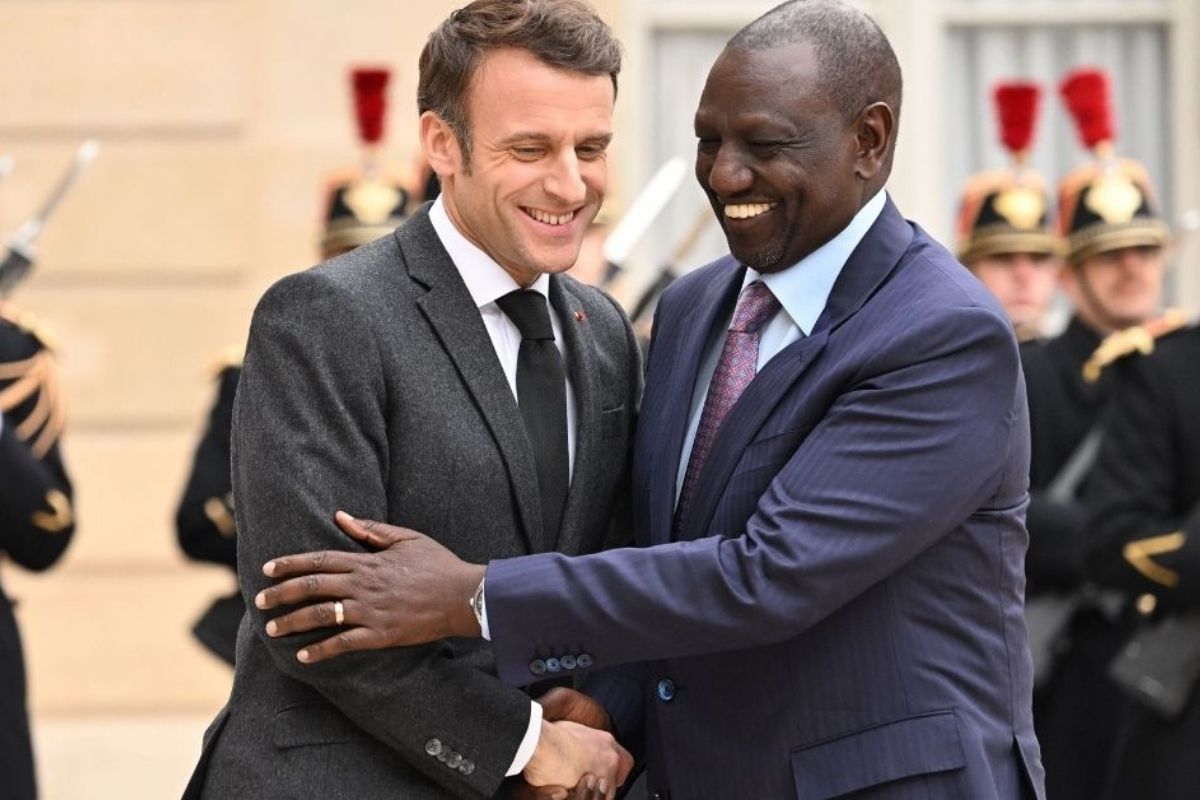
Emmanuel Macron and William Ruto have been building a conspicuously warm relationship. Their alignment is not sentimental. It is strategic. Macron needs credible African partners beyond the shrinking comfort zone of traditional French influence. Ruto wants greater international stature, broader elite access, and recognition as a serious continental player. The relationship serves both men.
The symbolism around their diplomacy speaks loudly. A major Africa-France summit being co-hosted outside Francophone Africa is not a scheduling detail. It is a statement. So is Ruto’s invitation into elite global gatherings as Macron’s guest. The partnership allows Macron to signal that France still matters in Africa, just in a revised form. It allows Ruto to signal that Kenya is now a preferred interlocutor between Africa and the Western powers.
In that sense, the Defence Cooperation Agreement is not just a military document. It is the legal scaffolding of a political relationship. It formalizes a mutual usefulness that extends beyond security. Ruto gets prestige. Macron gets re-entry. Kenya provides terrain. France provides status. Each side offers the other something the other presently lacks.
Kenya’s calculation is not foolish. It may still be dangerous.
To say all this is not to claim Kenya is naive. Nairobi is making a deliberate calculation.
The government likely believes that it can gain the benefits of French partnership without falling into the worst patterns associated with France’s older military relationships on the continent. It likely believes Kenya’s institutions are mature enough to contain the risks. It likely believes the country’s security needs, diplomatic ambitions, and global aspirations justify a closer defence relationship with Paris.
That calculation is not irrational. But neither is it automatically wise.
Because many of the countries that have pushed France out did not do so because cooperation itself was impossible. They did so because the accumulated experience of French military presence had come to symbolize compromised sovereignty, selective accountability, and a post-colonial arrogance dressed up as partnership. Mali, Burkina Faso, Niger, and even Senegal concluded that the costs had grown too large. Kenya is looking at the same global story and arriving at the opposite conclusion: not rejection, but managed engagement.
The question is whether Kenya can truly manage what others concluded was inherently imbalanced.
Partnership or tiered sovereignty?
This is the heart of the matter.
No serious state can isolate itself from international defence cooperation. That is not the issue. The issue is the form cooperation takes and the hierarchy it encodes. When foreign troops can enter with exceptional freedom, carry arms under foreign licensing, import equipment beyond normal scrutiny, and remain substantially tethered to their own legal system when harm occurs, the arrangement begins to look less like equal partnership and more like tiered sovereignty.
In such systems, the host nation remains sovereign in the ceremonial sense. Flags still fly. Speeches still invoke partnership. Ratification still happens. But beneath that formal equality, one side enjoys a negotiated superiority that tells you everything about the real structure of power.
This is why the optics in Mombasa mattered. Those warships were not just vessels. They were metaphors. They announced that France, having been battered elsewhere, had found a new corridor into Africa. And Kenya, instead of asking the hardest possible questions, seemed eager to present itself as the gateway.
The real test will come later
For now, the agreement can be defended through briefings, strategic language, and official optimism. But treaties reveal themselves most clearly not when they are signed, but when they are tested.
The real test will come when there is misconduct. When a Kenyan community raises an allegation. When a death, an injury, an abuse, or a scandal forces the system to choose between diplomatic comfort and constitutional seriousness. That is when the phrases “official duty,” “primary jurisdiction,” and “bilateral cooperation” will stop sounding technical and start determining whether justice is close or impossibly far away.
That is why Agnes Wanjiru still stands at the center of this story. Her name reminds Kenya that military agreements do not remain in policy papers. They descend into ordinary life. Into towns near bases. Into roads, bars, homes, and hotels. Into communities that discover too late that sovereignty on paper does not always protect the vulnerable in practice.
Emmanuel Macron needed a new African foothold. William Ruto needed a powerful friend at the highest global tables. The Kenya-France Defence Cooperation Agreement is where those two needs met.
But Kenya must ask itself a harder question than either leader may wish to answer publicly. In giving France this new foothold, what exactly has Kenya made firmer: its security, or France’s relevance? Its sovereignty, or its dependence? Its constitutional promise, or its tolerance for legal asymmetry?
Those are the questions that linger long after the ships have left the harbour.
And those are the questions that should make every Kenyan watch this deal with deep, unsleeping seriousness.