











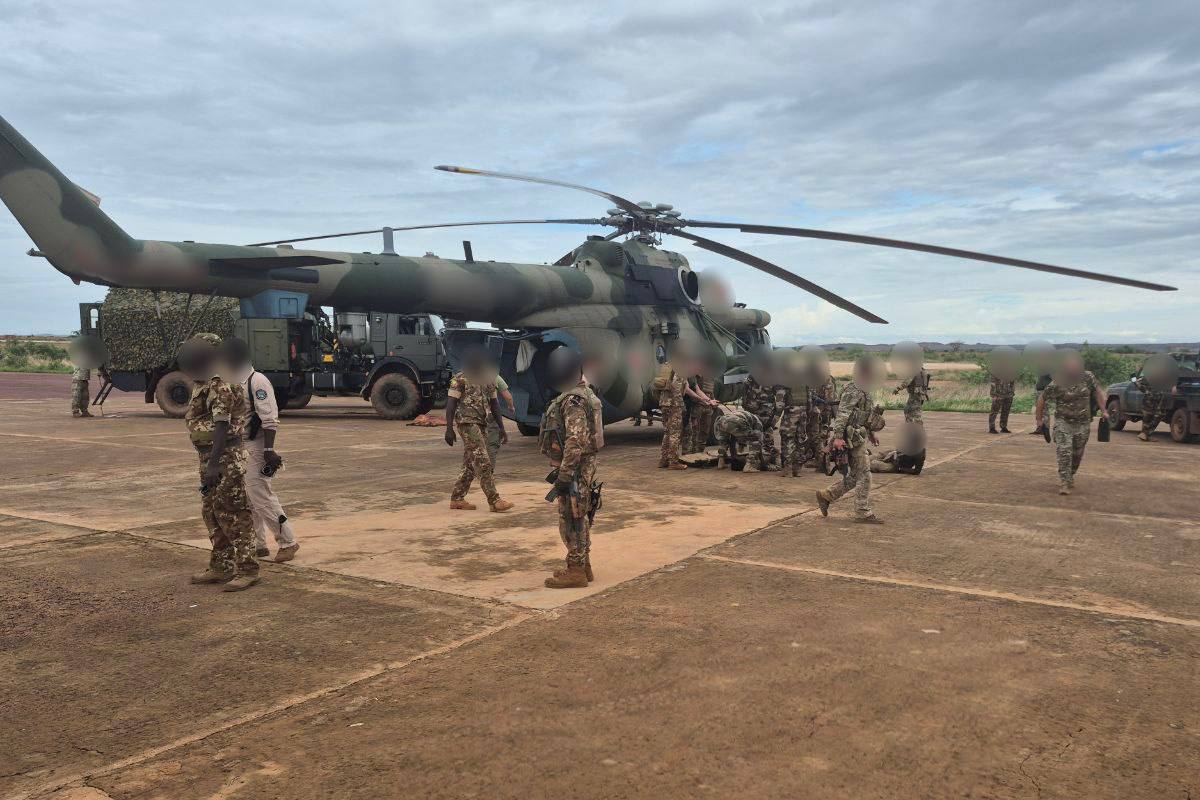
The war in Mali is no longer a distant northern storm. It is no longer just the story of desert rebels, remote garrisons, and forgotten borderlands. It is creeping toward the arteries of the state. It is spreading from the sands of Kidal and Tessalit to the roads around Bamako, the villages of Koulikoro, and the psychological heart of Mali’s sovereignty.
That is why a short battlefield statement from Russia’s Africa Corps deserves careful attention. Not blind applause. Not instant dismissal. Careful attention.
According to Africa Corps, “the situation in the Republic of Mali continued to be difficult.” The statement claims that “the enemy” moved reinforcements from neighboring countries to compensate for battlefield losses. Then comes the operational detail: on May 1, 2026, an Orion UAV allegedly detected militants in a wooded area near Koblébougou, in Koulikoro region. After the group reportedly began setting up a field camp, Africa Corps says they were struck with guided munitions.
On the surface, this reads like a routine military update. Drone sees enemy. Enemy gathers. Enemy is hit. Case closed.
But in Mali today, nothing is routine. Every battlefield statement is also a political statement. Every drone strike is also a message. Every claim of victory sits inside a thick fog of war, propaganda, fear, and national trauma.
The first important detail is geography. Koblébougou is not Kidal. It is not Tessalit. It is not the far north where many outsiders lazily imagine Mali’s conflict to be permanently trapped. It is in Koulikoro region, the belt around Mali’s political and military core. If Africa Corps’ statement is accurate, then this is not merely a northern Mali story. It suggests a conflict stretching into regions much closer to the capital and the state’s centre of gravity.
That matters deeply.
In recent days, Mali has faced unprecedented assaults across the country by Jama’at Nusrat al-Islam wal-Muslimin, widely known as JNIM, in coordination with the Tuareg-dominated Azawad Liberation Front, or FLA. Bases across Mali and near Bamako were hit, Kidal was seized, and Mali’s defence minister was killed in the attacks. JNIM-linked insurgents also set up checkpoints on major routes around Bamako and threatened a blockade of the capital.
This is the terrifying context in which the Africa Corps statement lands. It is not just saying: we hit militants. It is saying: the enemy is moving, regrouping, crossing borders, and trying to build operational depth. It is also saying: Russia’s Africa Corps is still present, still watching, still striking, still part of Mali’s war machine.
For Bamako, this message is politically useful. Mali’s military government has built much of its legitimacy on the promise that it can reclaim sovereignty, end dependency on France, restore territorial integrity, and defeat armed groups that have humiliated the state for more than a decade. The partnership with Russia became part of that promise. After French forces were pushed out, Moscow stepped in through Wagner and later Africa Corps.
Africa Corps is a Russian Defence Ministry unit that emerged as Moscow reorganized its African security operations after the Wagner Group began winding down following the death of its leader, Yevgeny Prigozhin, in 2023. In Mali, Africa Corps effectively inherited Wagner’s role as Russia’s main military partner to Bamako. This came after Assimi Goïta’s government pushed French forces out in 2022, ending a deployment in which France had previously stationed more than 4,000 troops across the Sahel.
So when Africa Corps says it has spotted and struck militants, it is not just reporting a military action. It is defending the credibility of Mali’s new security doctrine.
But here is where transformative pan-Africanism must remain awake.
Mali has every right to defend itself. No serious African patriot should romanticize armed groups that terrorize civilians, sabotage roads, attack military bases, carve up national territory, and suffocate ordinary people through fear. A sovereign state cannot simply watch as its towns fall, its soldiers are ambushed, its citizens are trapped, and its borders become corridors of insurgency.
But sovereignty is not a slogan. Sovereignty is not a drone video. Sovereignty is not proved by every communiqué that says “terrorists were neutralized.”
True sovereignty requires truth.
And in Mali, truth is now one of the main battlefields.
Africa Corps claims militants were struck near Koblébougou. The claim may be accurate. It may be partially accurate. It may omit crucial details. Independent verification remains difficult. That is not a small footnote. It is the central problem of modern war. Armed groups exaggerate their victories. Governments minimize their setbacks. Foreign military partners frame their interventions as decisive. Social media turns fragments into certainty. In the Sahel, a blurry video can become a national myth before anyone knows what actually happened.
Militant groups in Mali have expanded their reach across the region despite years of interventions by French, U.S., UN, and Russian forces. These groups now stretch across a vast corridor from western Mali near Senegal, through Nigeria, and into Chad. That is the hard reality Africa Corps’ statement cannot erase. One drone strike may disrupt a camp. It does not automatically defeat an insurgency.
The latest attacks also show how complex Mali’s battlefield has become. This is not one neat war. There are jihadist groups with transnational ambitions. There are Tuareg separatist formations with their own territorial and political agenda. There are local grievances. There are military factions. There are communities caught between armed actors. There are borders with Algeria, Niger, Burkina Faso, Mauritania, Senegal, and Guinea that are difficult to control. There are smuggling routes, gold interests, old rebellions, new alliances, and foreign powers all reading Mali through their own strategic lenses.
Mali’s authorities have accused some military officers of complicity with jihadists and separatists in recent attacks. The public prosecutor at the Military Court of Bamako said investigations had found evidence involving serving and recently dismissed officers in the planning, coordination, and execution of attacks.
This allegation of internal complicity is explosive. If true, Mali’s crisis is not just external. It is not simply “foreign-backed terrorists versus patriotic soldiers.” It is also a crisis of trust inside the state itself. A country can buy drones, import fighters, and issue hard statements, but if loyalty inside the security apparatus is fractured, then the war becomes much more dangerous.
This is why the Koulikoro claim matters. A strike near Koblébougou suggests a state trying to prevent armed groups from building camps and corridors closer to the capital. But it also suggests a conflict whose geography is widening. If militants can move reinforcements from neighboring countries, as Africa Corps claims, then Mali’s war is regional by nature. No single capital can bomb its way out of a regional insurgency while neighboring territories remain porous, unstable, or politically disconnected.
There is also the question of foreign military involvement. For many Malians and many pan-Africans, the French era became synonymous with humiliation. Years of French-led counterterrorism did not deliver lasting security. Operation after operation came and went. Bases remained. Speeches were made. Yet armed groups expanded. Many Africans therefore understood Bamako’s decision to expel France as a historic act of defiance.
But expelling France is not the same thing as building independence.
Replacing Paris with Moscow does not automatically produce sovereignty. It may produce leverage. It may produce weapons. It may produce tactical victories. It may give Bamako a partner less interested in lecturing it about democracy. But dependency can change accent without changing structure. A truly sovereign Mali must not become a chessboard where one external power is removed only for another to become indispensable.
The scale and coordination of the April 25–26 attacks challenged the narrative of regained sovereignty and security projected by Mali’s military leaders and the Alliance of Sahel States. Security cannot be delivered by military means alone. That point should not be dismissed as Western condescension. It is a painful African truth. Military power is necessary when armed groups are killing and occupying. But military power alone cannot heal broken citizenship.
Mali’s crisis began long before Russia arrived. It did not begin with one coup, one foreign base, one rebel movement, or one failed peace agreement. It emerged from decades of uneven development, distrust between centre and periphery, weak governance, corruption, external meddling, community grievances, trafficking networks, and the collapse of state authority in vast territories. A drone can destroy a camp. It cannot build a school in a neglected village. It cannot reconcile a family that has lost sons to different sides of the war. It cannot rebuild trust between Bamako and communities that feel ruled, not represented.
This is where pan-African clarity becomes urgent.
We must defend Mali’s territorial integrity without becoming stenographers of military propaganda. We must oppose jihadist terror without pretending every state action is automatically just. We must reject foreign manipulation without ignoring local grievances. We must celebrate African agency without confusing agency with militarized bravado.
Because the civilians of Mali are not hashtags. They are traders facing blocked roads. They are mothers wondering whether buses can still travel safely. They are young soldiers sent into a war whose politics they may barely understand. They are villagers who hear drones above them and armed men around them and do not know whose version of the truth will survive the night.
The Africa Corps statement tells us one thing clearly: Mali’s war is still active, still shifting, still dangerous. It tells us that Russian-backed surveillance and strike capabilities are now part of Bamako’s security response. It tells us that the conflict is not contained in the romanticized map of “the north.” It is pressing into wider national space.
But the statement does not tell us whether the strike killed only militants. It does not tell us whether the alleged reinforcements from neighboring countries were independently tracked. It does not tell us whether this action will reduce the threat or merely provoke another cycle. It does not tell us whether Mali is moving toward peace or simply deeper into a war of communiqués, drones, retaliations, and competing flags.
That is the larger tragedy.
Mali is fighting for sovereignty. That fight is legitimate. But sovereignty cannot be measured only by the number of enemies struck from the sky. It must be measured by whether the state can protect civilians, govern fairly, control its territory, tell the truth, hold its partners accountable, and offer every community a believable stake in the republic.
So yes, if militants were setting up a field camp near Koblébougou, Mali had the right to act. But after the smoke clears, the deeper question remains.
Can drone strikes, foreign alliances, and battlefield victories deliver the Mali that Malians deserve?
Or will real sovereignty require something harder: truth, justice, development, discipline, national healing, and a state strong enough not only to fight for its people, but to finally serve them?