












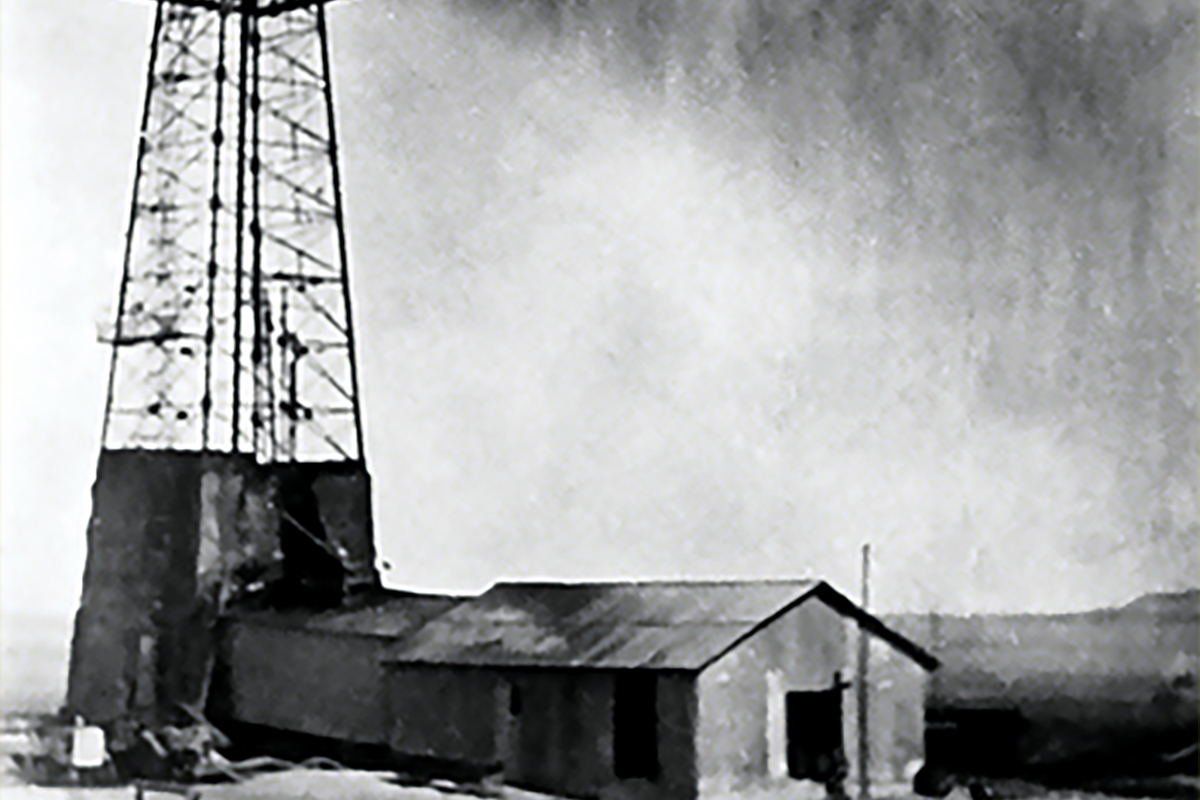
By early 1938, Standard Oil of California was close to giving up on Saudi Arabia altogether. Six wells had failed, costs were mounting, and the wider exploration campaign had already been sharply scaled back, with other drilling operations halted as confidence drained away. Chief geologist Max Steineke was recalled to San Francisco while the company weighed ending the Saudi venture. But he made one last case: let Dammam No. 7 finish the job. On March 3, 1938, that gamble changed the world. Commercial oil burst from the ground near Dhahran, turning a cash-strapped desert kingdom into a future petro-state and giving the United States the foundation of a Gulf partnership that would shape global power, finance, and energy for decades.
That partnership has become even more expansive under the second Trump administration. The reason is not sentiment. It is scale, breadth, and strategic convergence. In 2025 and 2026, Washington and Riyadh moved beyond the old oil-for-security formula into a broader compact spanning defense, artificial intelligence, critical minerals, capital markets, and civil nuclear cooperation. The White House said the two countries signed a Strategic Defense Agreement, an AI Memorandum of Understanding, a critical minerals framework, and a declaration completing negotiations on civil nuclear cooperation.
A $142 billion arms package is part of this new agreement. The White House describes is as the largest defense cooperation deal in U.S. history, alongside a broader $600 billion Saudi investment commitment tied to U.S. firms and infrastructure. That is why it is fair to argue that the partnership is now at its strongest in practical scope.
What makes this phase different is that Saudi Arabia is no longer engaging America only as an oil customer or arms supplier. It is engaging America as a co-architect of the next industrial frontier. Nvidia, an American company, agreed to supply Saudi-backed Humain with hundreds of thousands of advanced AI chips over five years, beginning with 18,000 Blackwell chips, while AMD announced a $10 billion strategic partnership.
The White House said Saudi-linked DataVolt would invest $20 billion in U.S. AI data centers and energy infrastructure. In other words, the old petrodollar relationship is mutating into a techno-petrodollar relationship. Oil money is not merely buying Treasury securities or luxury assets. It is now helping shape the geographies of compute, chips, data centers, defense platforms, and strategic minerals.
That matters because petrodollars still shape the world profoundly, even if the mechanism has become more sophisticated. In the classical sense, petrodollars are the foreign exchange surpluses generated by oil exporters and recycled through global finance, trade, debt markets, sovereign wealth funds, defense procurement, and real asset acquisitions. In the contemporary sense, they also shape technology ecosystems, port infrastructure, logistics corridors, mining investments, sports, media, AI clouds, and industrial policy.
Saudi Arabia’s state and quasi-state investment machinery, including the Public Investment Fund, now moves capital at a planetary scale, while the Kingdom’s economic diplomacy increasingly reaches into the United States, Asia, Europe, and Africa.
In late 2025, that the PIF was around $925 billion and rethinking how to deploy capital more strategically. That is petrodollar power in mature form: not simply oil wealth, but oil wealth converted into global optionality.
Africa feels the force of this system from two directions at once. First, it remains exposed to the older oil order. Afreximbank has noted that 87 percent of African countries are net oil importers, meaning even a continent with major crude producers still suffers heavily when global fuel prices spike. AFREC, the African Union’s specialized energy agency, has also stressed that Africa is the only continent that is both a net exporter of crude oil and a net importer of petroleum products. Its data show African refineries with nameplate capacity of about 3.3 million barrels per day against product demand of around 4.1 million barrels per day in 2020, with operational and utilization problems making the gap even worse in practice. This is the heart of the trap: export the crude, import the vulnerability.
Second, Africa is increasingly touched by the newer petrodollar order, where Gulf capital helps shape African real estate, ports, logistics, mining, food systems, technology, and industrial zones. That can be beneficial, but only if African states enter those relationships with strategy rather than desperation.
As a case in point, Saudi Arabia’s Vision Invest participated in a $700 million capital raise for ARISE Integrated Industrial Platforms in 2025, one of the largest private infrastructure transactions in Africa. This is how contemporary petrodollars operate: not merely through oil tankers, but through industrial corridors and ownership structures. Africa is not outside the petrodollar world. It is being reorganized inside it.
That is why Africa’s energy question can no longer be framed only as “Where will we import fuel from?” It must be reframed as “How do we build enough energy, refining, and transmission at home to break structural dependence?” The starting point is that oil still matters for Africa. Not forever as the singular fuel of development, but decisively for the medium term.
Africa still needs diesel, jet fuel, petrochemicals, fertilizers, industrial heat, bitumen, lubricants, shipping fuels, and backup generation. Even the energy transition requires hydrocarbons in its current build-out phase. The mistake would be to imagine that Africa must choose between oil and modernity. The smarter argument is that Africa must capture more value from the oil and gas it already has while using that cash flow to build the solar-electric future that will reduce imported-fuel exposure over time.
And yes, oil and solar together can provide Africa with the energy it needs, right here in Africa, if the continent stops treating them as opposites and starts treating them as a staged strategy. Oil and gas can stabilize grids, support transport and industry, and finance infrastructure. Solar can slash power deficits, extend electricity into rural and peri-urban communities, reduce diesel dependence, and power new industries when paired with storage, grids, and flexible generation. IRENA says Africa’s renewable resource potential is about 1,000 times larger than projected electricity demand in 2040. That is not a slogan. That is an extraordinary structural advantage.
The key word, however, is not potential. It is deployment. Africa has long been rich in potential and poor in execution. The IEA says that for the past decade, roughly half of energy investment in Africa has gone into oil and gas, largely aimed at exports, while clean-energy spending remained below $30 billion a year until 2021. It also notes that South Africa and North Africa, with less than 20 percent of the population, account for more than 45 percent of energy investment and over 65 percent of installed electrical capacity, while much of sub-Saharan Africa remains underinvested and under-electrified. Africa does not lack sunlight. It lacks bankable grids, transmission, patient capital, storage, manufacturing depth, and state seriousness.
China shows what seriousness looks like. Its rise in solar has not been rhetorical. It has been industrial, relentless, and system-wide. China’s solar power capacity rose 45.2 percent in 2024 to 890 gigawatts, while wind reached 520 gigawatts. China’s combined wind and solar capacity hit 1,482 gigawatts by the end of March 2025, surpassing thermal power capacity for the first time.
In 2024, solar alone generated 8.3 percent of China’s electricity, producing 839 terawatt-hours, while China accounted for 53 percent of global solar growth that year. Those are not decorative statistics. They show what happens when a state treats solar as industrial power, grid power, and geopolitical power at once.
China’s example matters for Africa because it proves two things at once. First, solar is no longer a boutique or donor-driven technology. It is now one of the central pillars of serious national power strategy. Second, solar supremacy does not emerge from sunlight alone. China built manufacturing ecosystems, grid planning, financing mechanisms, transmission lines, industrial policy, and state-backed deployment. In other words, China did not become a solar giant because it had sunshine. It became a solar giant because it behaved like a civilization determined to dominate the future. The lesson for Africa is that abundant sun is valuable, but coordinated policy is what turns sunlight into sovereignty.
Africa’s case is, in some ways, even more compelling than China’s. Large parts of the continent have superior solar irradiation, enormous unmet electricity demand, vast room for distributed generation, and urgent need for new productive power. Solar mini-grids, utility-scale solar, rooftop systems, battery-backed commercial systems, and solar-powered irrigation can all move faster than traditional centralized models in many African contexts.
IRENA argues that renewables in Africa are not only a climate asset but a socio-economic one, with potential to reduce fossil fuel import costs, improve public health, expand jobs, and support green industrialization. That means solar in Africa is not merely about decarbonization. It is about ending darkness, lowering import bills, and multiplying domestic production.
Still, the continent should resist magical thinking. Solar alone, without grids, storage, industrial demand planning, and complementary dispatchable power, will not instantly solve Africa’s full energy problem. That is precisely why the strongest argument is for an oil-plus-solar strategy, not an oil-versus-solar argument. Oil and gas can help underwrite fiscal capacity and reliability in the near to medium term. Solar can drive electrification, reduce diesel use, and prepare Africa for the electricity-heavy economy now emerging worldwide. The IEA’s 2025 outlook says global electricity demand rose 4.3 percent in 2024, a sharp acceleration, with electrification pushing power demand higher across sectors. Africa cannot enter that age of electricity with the energy architecture of dependency.
So what should Africa do? First, it should refine more of its own crude and move petroleum products more efficiently across regional markets. Second, it should build strategic fuel reserves and storage to reduce exposure to shipping shocks and speculative price spikes. Third, it should massively expand transmission and distribution systems so new generation can actually reach homes, farms, mines, factories, and data centers. Fourth, it should treat solar manufacturing, assembly, inverters, batteries, and grid equipment as industrial policy priorities rather than mere import categories. Fifth, it should use oil, gas, and mining revenues to capitalize African energy banks, not only sovereign consumption. Sixth, it should negotiate with Gulf, Western, and Chinese capital from a position of continental purpose, not fragmented urgency.
The deeper lesson of Dammam No. 7 is not simply that one well made one kingdom rich. It is that control over energy systems creates geopolitical adulthood. Saudi Arabia turned a desert strike into state power. The United States turned that state power into strategic partnership. Under Trump’s second administration, that partnership has widened beyond oil into defense, AI, nuclear energy, capital markets, and critical minerals. The petrodollar system has not faded. It has evolved. It now helps shape the commanding heights of the twenty-first century.
Africa must answer with equal ambition. It has the oil. It has the sun. It has gas, hydro, wind, geothermal corridors, critical minerals, youthful labor, and vast unmet demand. What it lacks is not energy endowment. What it lacks is a continental doctrine that insists African resources must first produce African power, African industry, and African resilience. If China can turn solar into national strength, and Saudi Arabia can turn oil into global leverage, then Africa can turn oil plus solar into the foundation of genuine energy sovereignty. The resources are already here. The real question is whether the strategy will finally be African too.