













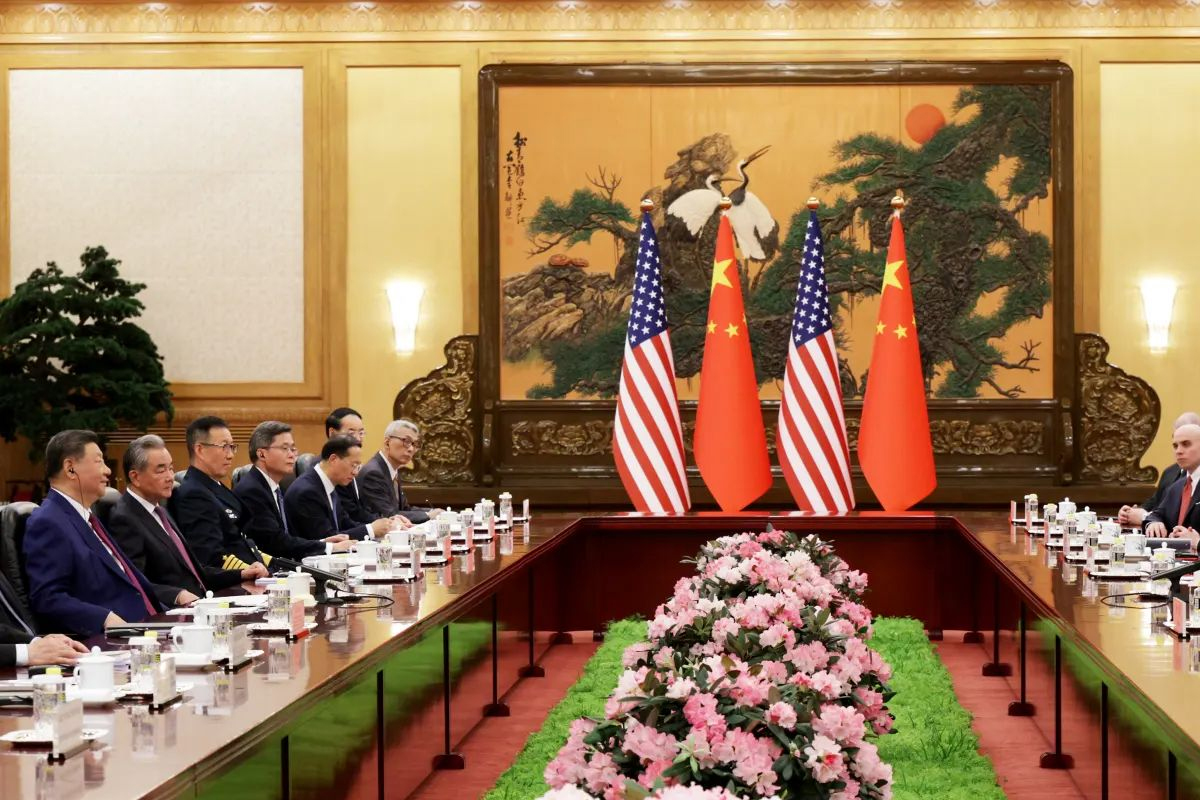
There are moments in global politics when power is not hidden in speeches, communiqués, press conferences, or diplomatic smiles. It is sitting quietly at the table.
That is why Africa must pay attention to two tables.
The first is the U.S.-China summit table in Beijing, where two economic giants sit across from each other with the full weight of their national economies behind them. The second is the France-Africa summit table in Nairobi, where France engages African countries whose collective resources are immense but whose economic power remains painfully fragmented.
One table reveals what economic scale looks like.
The other table reveals what fragmented potential looks like.
And between those two tables lies one of the most important questions of the twenty-first century: will Africa continue negotiating with the world as scattered countries carrying continental wealth, or will it finally build the unified economic ecosystem necessary to convert its resources into power?
The Table of Giants
When the United States and China meet, the world pays attention because both countries carry extraordinary economic weight.
According to the IMF’s April 2026 World Economic Outlook projections, the United States has a nominal GDP of about US$32.38 trillion, while China’s economy stands at about US$20.85 trillion. The IMF places the world economy at about US$126.3 trillion, which means the United States and China together account for roughly 42% of global GDP.
That number is not just economic trivia. It is diplomatic muscle. It is military confidence. It is technological leverage. It is currency power. It is negotiating power.
When Washington speaks, the world listens partly because behind it sits a US$32 trillion economy. When Beijing speaks, the world listens partly because behind it sits a US$20 trillion economy.
This is why U.S.-China tensions matter to the whole world. Their disputes over trade, technology, tariffs, shipping routes, artificial intelligence, semiconductors and security are not merely bilateral issues. They shape the global economy because the two countries are not peripheral players. They are pillars of the world economy.
That is the first table: a table of giants.
The Table of Fragmented Potential
Now consider the second table: the France-Africa summit table in Nairobi.
France comes to such a table as a major economy. IMF projections place France’s 2026 nominal GDP at roughly US$3.6 trillion. Kenya, by contrast, is a dynamic and strategically important African economy, but its latest World Bank current-dollar GDP figure for 2024 was about US$120 billion.
That comparison is sobering. France’s economy is roughly 26 to 30 times larger than Kenya’s, depending on the source and year used. The United States is more than 200 times larger than Kenya, while China is more than 150 times larger.
This is not an insult to Kenya. Kenya has world-class talent, strategic geography, geothermal power, agricultural capacity, a vibrant technology ecosystem, a globally admired athletic culture, and one of Africa’s most energetic private sectors.
But economics rewards scale.
Kenya alone cannot negotiate with France, China, or the United States as an equal economic force. The issue, therefore, is not Kenya’s dignity. The issue is Africa’s fragmentation.
When an individual African country sits with a major global power, the imbalance is often overwhelming. But when Africa’s countries act separately, they turn continental wealth into national vulnerability.
Africa’s Collective Paradox
Now zoom out.
Africa is not poor in potential. It is not poor in resources. It is not poor in people. It is not poor in land, sunlight, minerals, culture, agricultural possibility or strategic geography.
Yet Africa’s collective economic output remains shockingly small relative to its natural and human wealth.
The African Continental Free Trade Area is often described as creating a market of about 1.3 billion people with a combined GDP of around US$3.4 trillion.
Pause there.
Africa as a continent is roughly in the same nominal GDP neighborhood as France.
A continent of more than a billion people. A continent with vast shares of the world’s mineral wealth. A continent central to the future of batteries, electric vehicles, solar panels, food security, digital labor, critical minerals and global youth demographics. Consider just three minerals: cobalt, tantalum/coltan, and manganese.
The Democratic Republic of Congo alone accounted for an estimated 76% of global cobalt mine production in 2024, while holding about 6 million tonnes of cobalt reserves out of a global total of roughly 11 million tonnes. Cobalt is indispensable to many lithium-ion batteries that power electric vehicles and digital devices. Africa is also central to tantalum, commonly associated with coltan, which is essential for capacitors used in electronics and advanced technologies. In 2024, African countries together produced roughly 1,717 tonnes out of a world total of 2,100 tonnes, or about 82% of global tantalum mine production, led by the DRC, Rwanda, Nigeria, Mozambique, Ethiopia, and Burundi.
Then there is manganese, vital for steelmaking and increasingly important for battery technologies. South Africa alone holds about 560 million tonnes of manganese reserves, while Gabon holds about 61 million tonnes; together, these two African countries account for about 621 million tonnes out of the world’s 1.7 billion tonnes of manganese reserves, or roughly 37% of global reserves. Even more striking, USGS notes that South Africa accounts for an estimated 70% of the world’s manganese resources. Yet in nominal GDP terms, the entire African continent remains comparable to one European power. That is the scandal: Africa is central to the material future of the world, but still peripheral in the ownership, processing, pricing, and industrial command of that future.
That is the scandal.
Not because France is small. France is a major economy. But because Africa should be far bigger.
Africa should not be economically comparable to one former colonial power. Africa should be negotiating as a continental civilization with the economic force of its population, resources, production systems and markets fully integrated.
But Africa is not there yet.
The Numbers Tell a Story
The numbers tell a hard story:
| Economy | Approximate nominal GDP |
|---|---|
| United States | US$32.38 trillion |
| China | US$20.85 trillion |
| France | US$3.6 trillion |
| Africa combined | About US$3.3–3.4 trillion |
| Kenya | About US$120 billion |
These figures reveal one central truth: Africa is rich in resources but poor in coordinated economic power.
The United States has one federal market. China has one national market. France is embedded within the wider machinery of the European Union. But Africa still behaves too often like 54 separate economic islands.
Different customs systems. Different currencies. Different regulations. Different standards. Different visa regimes. Different railway gauges. Different power grids. Different colonial languages. Different political anxieties. Different external patrons.
This is why a mineral can leave Africa faster than an African entrepreneur can move goods across an African border.
This is why African raw materials can travel to Europe or Asia more easily than finished African products can travel from Lagos to Nairobi, Accra to Addis Ababa, or Dar es Salaam to Kinshasa.
That is not normal. It is engineered weakness.
Africa Exports Wealth and Imports Dependency
Africa’s problem is not absence of wealth. Africa’s problem is the structure through which its wealth is processed.
Africa exports cocoa but imports chocolate.
Africa exports crude oil but imports refined fuel.
Africa exports cotton but imports clothing.
Africa exports lithium, cobalt, manganese and copper but imports batteries, electronics and machines.
Africa exports coffee but imports branded coffee culture.
Africa exports young talent but imports development lectures.
This is the architecture of dependency.
The raw material leaves cheaply. The finished product returns expensively. The job leaves. The technology leaves. The branding leaves. The profit leaves. Then Africa is invited to a summit and told to be grateful for investment.
That is why GDP alone is not enough. The deeper question is: who controls the value chain?
If Africa remains a supplier of raw materials, it will remain trapped at the bottom of global production. If Africa builds continental value chains, it can begin to turn resources into industries, industries into jobs, jobs into tax revenue, and tax revenue into sovereignty.
Why Fragmentation Makes Africa Vulnerable
When African countries negotiate individually, they become vulnerable to pressure.
A country with a GDP of US$20 billion, US$50 billion or US$100 billion can be pressured through debt, aid, trade preferences, military cooperation, currency systems, ratings agencies, visa policy, diplomatic isolation or so-called technical assistance.
This is how unequal partnerships are born.
Not always through guns. Not always through coups. Not always through flags.
Sometimes unequal power is hidden inside a loan agreement. Sometimes it is hidden inside a mining contract. Sometimes it is hidden inside a defence deal. Sometimes it is hidden inside a trade clause. Sometimes it is hidden inside a summit photograph.
That is why the table matters.
The seating arrangement can reveal the structure of power.
The Great African Contradiction
Africa is indispensable to the future of the world, yet still treated as peripheral in the present global economy.
How can Africa be central to the future of electric vehicles but peripheral in battery manufacturing?
How can Africa be central to the future of food security but still import huge quantities of food?
How can Africa be central to solar energy but still have millions without reliable electricity?
How can Africa be central to global youth demographics but still export its young people into migration desperation?
How can Africa be central to the world’s mineral future but remain absent from the commanding heights of industrial production?
This contradiction exists because Africa’s resources are continental, but Africa’s economic systems are fragmented.
The wealth is continental. The bargaining is national.
The minerals are continental. The contracts are national.
The population is continental. The markets are broken into borders.
The dream is Pan-African. The infrastructure is still too colonial.
AfCFTA Must Become Africa’s Economic Liberation Infrastructure
This is why the African Continental Free Trade Area matters.
The African Union describes the AfCFTA as a project aimed at accelerating intra-African trade and boosting Africa’s global trading position by strengthening the continent’s common voice and policy space in global trade negotiations.
That phrase is crucial: common voice.
Without a common voice, Africa is a chorus of whispers. With a common voice, Africa becomes a negotiating force.
The World Bank has estimated that full implementation of AfCFTA could boost regional income by 7%, or about US$450 billion, and lift 30 million people out of extreme poverty by 2035.
Those numbers are not abstract. They represent factories, jobs, dignity, household income, stronger local businesses, wider tax bases, reduced migration pressure and greater African bargaining power.
But AfCFTA must not be treated merely as a trade agreement. It must be treated as Africa’s economic liberation infrastructure.
It must become the bridge between Africa’s scattered markets and Africa’s unified economic power.
The Abuja Treaty: Africa Already Signed the Blueprint
Africa is not starting from zero.
Africa already signed the blueprint.
On June 3, 1991, African leaders adopted the Treaty Establishing the African Economic Community, popularly known as the Abuja Treaty. It entered into force on May 12, 1994. The African Union records both the adoption date and the entry-into-force date, making clear that this was not a vague aspiration but a formal continental treaty.
The Abuja Treaty was designed as a roadmap for progressive African economic integration. Its logic was simple but profound: strengthen regional economic communities, move toward a continental common market, deepen coordination of economic policies, and ultimately build the institutions of an African Economic Community.
Most importantly, the treaty envisioned a final stage involving a Pan-African Economic and Monetary Union, including an African Central Bank and the creation of a single African currency.
That vision should not be dismissed as fantasy. It should be treated as a strategic destination.
A common African currency cannot be created recklessly. It cannot be built on slogans. It cannot be imposed on weak production systems, unstable fiscal policies and disconnected economies. A premature currency union would be dangerous.
But that does not mean the ambition is wrong.
A common African currency, properly prepared, would not merely be about money. It would be about power. It would reduce transaction costs within Africa. It would support continental trade. It would reduce unnecessary dependence on external currencies. It would help create a united African financial ecosystem.
Today, one of Africa’s economic absurdities is that two African countries can trade with each other, yet the payment architecture may still be mediated through external currencies and external systems. Even when Africa trades with Africa, part of the bloodstream of that trade remains outside Africa.
The Abuja Treaty understood this problem decades ago.
That is why Africa must stop treating the treaty like an old document in an archive. It must become a living engine.
The call should be clear: fully activate the Abuja Treaty, fully operationalize the African Economic Community, and place AfCFTA within the larger journey toward a united continental financial ecosystem.
Africa needs interoperable payment systems. Africa needs stronger African development finance. Africa needs an African Monetary Fund. Africa needs an African Investment Bank. Africa needs a credible path toward an African Central Bank. Africa needs disciplined monetary coordination rooted in production, not fantasy.
A common currency without productive integration can become a trap. But productive integration without monetary ambition can remain incomplete.
The Abuja Treaty was not just a treaty. It was Africa’s unfinished economic declaration of independence.
What Economic Unity Must Look Like
Economic unity must be practical. It cannot survive as poetry alone.
First, Africa must prioritize value addition. Cocoa must become chocolate. Cotton must become fashion. Cobalt must become batteries. Lithium must become storage systems. Coffee must become branded African coffee culture. Gold must become financial instruments, jewelry, reserves and industrial products.
Second, Africa must build continental infrastructure. Roads must connect production zones to regional markets. Rail must connect ports to inland economies. Energy grids must cross borders. Digital infrastructure must integrate payments, identity and trade systems.
A border that delays a truck for five days is not just a border. It is a tax on African unity.
Third, Africa must harmonize common standards. African businesses should not need to fight 54 regulatory battles to sell across the continent. Packaging rules, certification systems, food safety standards, pharmaceutical rules, customs processes, digital regulations and professional qualifications must become easier to navigate.
Fourth, Africa must build African finance. Trade cannot be truly liberated if African countries remain dependent on external financial pipes to trade with one another. The continent needs payment systems, credit systems and investment institutions that serve African production.
Fifth, Africa must develop regional industrial corridors. East Africa should not only export agricultural products. West Africa should not only export cocoa and oil. Southern Africa should not only export minerals. North Africa should not only serve as a bridge to Europe. Central Africa should not only be treated as a forest and mineral reserve.
Each region must become part of a continental production machine.
Africa United Is a Market. Africa Divided Is a Marketplace
This is the diplomatic lesson of the two tables.
At the U.S.-China table, power recognizes power.
At the France-Africa table, power studies fragmentation.
France does not need to be larger than Africa in reality. France only needs Africa to remain divided in practice.
China does not need every African country to be weak. China only needs each African country to negotiate alone.
America does not need Africa to be poor. America only needs Africa to lack a unified economic strategy.
The same applies to Europe, India, Russia, Turkey, the Gulf states and every external power.
External powers understand scale. That is why they negotiate with the European Union as a bloc, but often engage African countries one by one.
Africa united is a market.
Africa divided is a marketplace.
A market sets terms.
A marketplace receives buyers.
The Nairobi Lesson
When France comes to Nairobi, Africa must ask hard questions.
Is this a partnership of equals? Or is it part of a wider repositioning by France after rejection and resistance in parts of its old West African sphere?
Kenya should talk to France. Africa should talk to Europe. Africa should talk to China, America, India, Russia, Turkey, Brazil, the Gulf and the whole world.
But Africa must not engage the world as scattered dependency zones.
Africa must engage the world as a strategic civilization.
That requires economic unity.
This Is About Ordinary Africans
This debate is not only about presidents and summits.
It is about the Kenyan graduate looking for work. The Ghanaian cocoa farmer denied chocolate profits. The Congolese miner whose minerals power global technology but not local prosperity. The Nigerian entrepreneur blocked by payment barriers. The Ethiopian manufacturer trapped by market fragmentation. The Senegalese fisherman watching foreign fleets extract wealth from African waters. The Zambian copper belt worker seeing copper leave and machines return.
Economic fragmentation decides whether African youth get jobs.
It decides whether African farmers earn dignity.
It decides whether African minerals build African industries.
It decides whether African governments collect enough revenue to build schools, hospitals, roads and research centers.
It decides whether African countries beg or bargain.
The Table Must Change
The U.S.-China table tells us what economic scale looks like.
The France-Africa table tells us what fragmented potential looks like.
One table is built on power. The other exposes a question.
Will Africa continue arriving as scattered countries carrying continental wealth? Or will Africa finally build the economic ecosystem that turns its resources into power?
Africa does not lack minerals. Africa does not lack people. Africa does not lack land. Africa does not lack history. Africa does not lack imagination.
Africa lacks the economic unity to convert all these blessings into bargaining power.
Until that changes, the world will keep inviting Africa to summits, praising Africa’s potential, photographing Africa’s leaders, signing Africa’s contracts, extracting Africa’s resources and leaving Africa with speeches.
But the day Africa becomes one economic ecosystem, the table changes.
The seating arrangement changes. The tone changes. The contracts change. The respect changes. The future changes.
Because then Africa will not come to the table as 54 vulnerable economies.
Africa will come as a continental force.
And that is the Africa the world is not ready for.
But that is the Africa we must build.
A united Africa will not beg for a seat at the table. A united Africa will build the table.