
















There are moments when a country’s wound becomes so deep that it forgets where the enemy is.
A construction site in South Africa’s North West province. Men in work clothes. Contractors. Local officials. Activists. A confrontation over jobs. But this time, the people being chased away are not Zimbabweans, Mozambicans, Nigerians, Malawians, or Congolese.
They are South Africans.
Their crime is not that they crossed an international border.
Their crime is that they came from Gauteng.
That is how dangerous scapegoating becomes. It begins by saying, foreigners are stealing our jobs. Then one day it says, people from the next province are stealing our jobs. Then it says, only people from this district belong here. Then it says, only people from this village. Eventually, a republic becomes a collection of fenced-off anxieties.
And every hungry community becomes a border post.
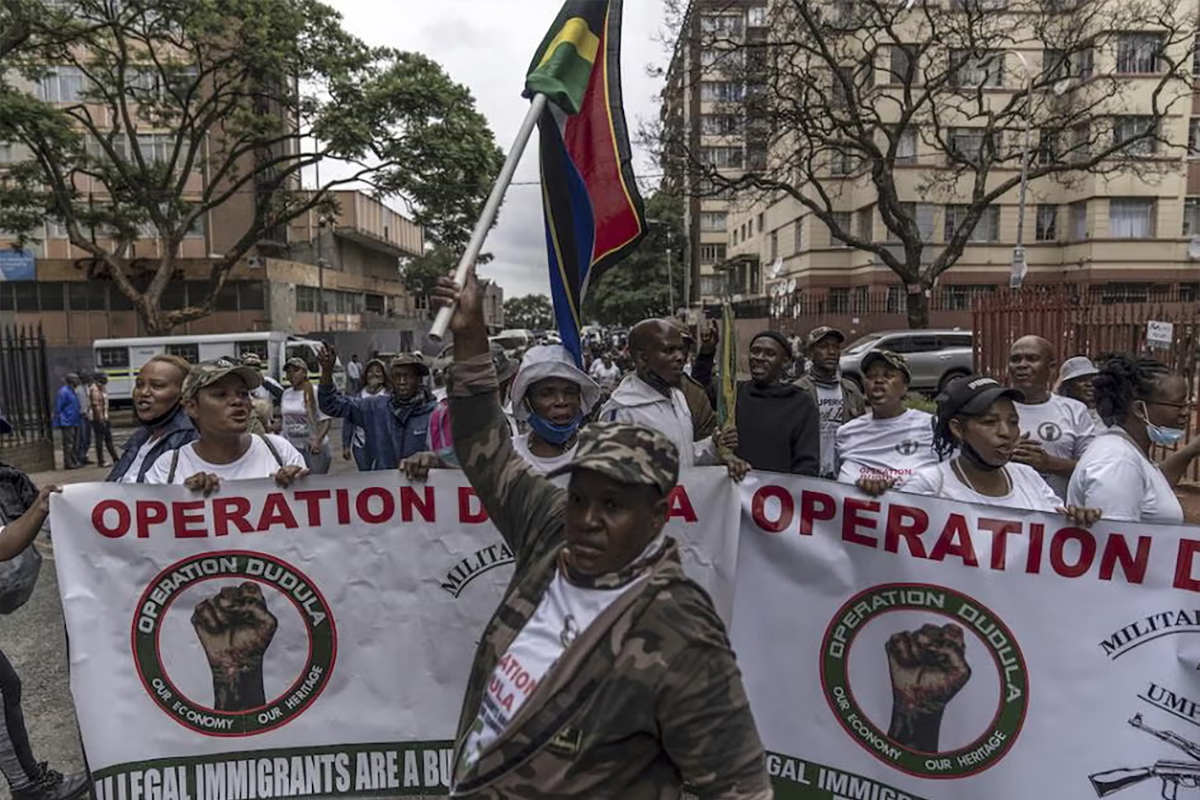
In South Africa’s North West Province, local activists and officials confronted employers and demanded that workers from Gauteng be removed so that only local North West residents, mostly from the Batswana community, could be hired. The specifics of this incident are still mostly being reported through social media clips and posts, but the larger pattern is not isolated: South Africa has already seen anti-migrant vigilante action around jobs, public services, and healthcare access.
In late 2025, Operation Dudula members blocked foreign nationals from public clinics in Gauteng, despite a Johannesburg High Court order against harassing migrants.
That is the road South Africa is now walking.
And it is a road that leads inward.
First, the anger was directed at foreign Africans. Now, it is being redirected toward fellow citizens. Tomorrow, it may be redirected toward neighboring ethnic groups, township outsiders, rural migrants, language communities, or anyone who can be marked as not belonging.
This is the anatomy of social collapse.
Not collapse as in buildings falling. Collapse as in the moral imagination shrinking.
A nation collapses when its people can no longer imagine one another as members of the same body.
South Africa was supposed to be the great post-apartheid experiment in constitutional citizenship. The idea was simple but profound: after centuries of racial classification, pass laws, Bantustans, forced removals, and engineered poverty, the new South Africa would build a different kind of belonging. Not belonging by tribe. Not belonging by white permission. Not belonging by labor category. Not belonging by where apartheid dumped your grandparents.
Belonging by citizenship.
Belonging by dignity.
Belonging by the Constitution.
But poverty has a brutal way of eating philosophy.
When jobs disappear, when tenders enrich a few, when construction projects arrive in poor communities without transparent local benefit, when young people watch cranes rise but their own lives remain stuck, anger begins to search for a face. And because the real systems are often too complex, too protected, or too politically connected, anger chooses the nearest vulnerable body.
The migrant.
The outsider.
The worker from Gauteng.
The person who is poor enough to be blamed, but not powerful enough to be responsible for your poverty.
That is the great trick of ruling elites. They turns victims into enemies of other victims.
A man from Gauteng did not deindustrialize South Africa.
A Zimbabwean nurse did not collapse municipal governance.
A Mozambican shopkeeper did not loot state-owned enterprises.
A Malawian gardener did not design youth unemployment.
A Congolese trader did not steal billions through corruption.
And a North West artisan looking for work is not the enemy of a North West youth looking for work.
They are often two men standing in the same burning house, fighting over the last cup of water, while the arsonists hold a press conference about stability.
This is why the North West incident matters.
It shows that xenophobia is not only hatred of foreigners. It is a political method. Once that method is normalized, it does not stop at the national border. It becomes a habit of mind. It teaches people to solve economic scarcity by expelling the nearest outsider.
And once that logic enters the bloodstream of society, everyone is eventually a foreigner somewhere.
A Venda person can become a foreigner in a Tswana-majority space.
A Xhosa worker can become a foreigner in a Zulu-majority space.
A Gauteng artisan can become a foreigner in North West.
A South African can become undocumented inside South Africa.
This is how Bantustan logic returns without apartheid’s old uniform.
Under apartheid, the state carved black South Africans into managed fragments. It told people where they belonged, where they could work, where they could sleep, where they could move, and which version of blackness was administratively acceptable. The post-apartheid Constitution tried to destroy that architecture. But today, when activists demand that only “locals” can work, the old ghost returns through new language.
It no longer says passbook.
It says local preference.
It no longer says Bantustan.
It says community protection.
It no longer says racial labor control.
It says economic justice.
But justice cannot be built by humiliating workers.
Justice cannot be built by chasing poor people from construction sites.
Justice cannot be built by turning provinces into tribal hiring zones.
Of course, the pain of local communities is real. To dismiss it would be arrogant. People in North West have every right to demand that development projects benefit local residents. They have every right to question contractors who import labor while local youth sit unemployed. They have every right to demand skills transfer, transparent hiring, community quotas, local procurement, and fair access to opportunity.
But the question is not whether local people deserve jobs.
They do.
The question is whether economic justice should be enforced by intimidation, humiliation, and exclusionary vigilantism.
That is where the moral line is.
Because when citizens begin to police employment through threats, the state has already failed twice. First, it failed to create enough opportunity. Then it failed to govern the anger produced by that failure.
And into that vacuum walk the strongmen of the street.
They arrive with cameras, slogans, ultimatums, and the addictive theatre of confrontation. They look courageous because they are confronting contractors. But the deeper test is whether they are confronting the actual structure of economic exclusion.
Are they confronting corrupt tender systems?
Are they confronting politically connected contractors?
Are they confronting poor skills planning?
Are they confronting the collapse of vocational pathways?
Are they confronting the inequality that makes one construction site feel like the only door into adulthood?
Or are they simply confronting other workers?
This is where the politics becomes dangerous.
Operation Dudula and similar anti-migrant movements rose by converting social pain into territorial suspicion. Thats how Operation Dudula moved from street-level anti-migrant vigilantism into formal party politics ahead of the 2024 elections, after building support across multiple provinces through campaigns against undocumented migrants. The group’s activities included blocking foreigners from clinics and targeting access to public services, turning healthcare into a battleground of citizenship and exclusion.
Now the logic appears to be mutating.
It is no longer only: foreigners must leave.
It is becoming: non-locals must leave.
That is not patriotism.
That is provincial fragmentation.
It is the slow privatization of national belonging.
And for Africa, the lesson is much larger than South Africa.
Because this is what happens when liberation movements win political power but fail to deliver economic dignity at scale. The flag changes. The anthem changes. The Constitution changes. But if the economy remains a narrow bridge guarded by a few, the masses begin pushing one another into the river.
A hungry people will always look for explanations.
If political education is weak, they will be given scapegoats.
If institutions are weak, they will be given vigilantes.
If leadership is cowardly, they will be given slogans.
If economic transformation is delayed for too long, the poor will eventually be mobilized against the poor.
This is why Pan-Africanism cannot remain a beautiful speech about unity. It must become a material program for jobs, housing, food, energy, mobility, skills, and dignity. A hungry Pan-Africanism will not survive the first rumor that someone from across the border, or across the province, has taken the last job.
The North West incident is therefore not a small local drama.
It is a warning.
It tells us that the crisis has moved from xenophobia to internal nativism. From national borders to provincial borders. From citizenship to sub-citizenship. From “foreigners are the problem” to “outsiders are the problem.”
And that is a road with no peaceful end.
Because once belonging is reduced to birthplace, every worker becomes suspicious. Every opportunity becomes a territorial war. Every construction site becomes a checkpoint. Every poor community becomes a miniature state. Every local activist becomes an immigration officer of despair.
South Africa must answer this moment with clarity.
Local economic participation is legitimate.
Vigilante exclusion is not.
Community benefit is necessary.
Provincial chauvinism is poison.
Jobs for locals can be a policy.
Chasing citizens from other provinces is a constitutional wound.
The solution is not to shame poor communities for being angry. The solution is to organize their anger upward, toward systems, not sideways, toward fellow workers. Demand binding local labor agreements. Demand transparent recruitment lists. Demand skills transfer. Demand anti-corruption audits. Demand contractor accountability. Demand public works that create real community wealth.
But do not turn the unemployed young man from Gauteng into the face of your suffering.
He is not your oppressor.
He is your mirror.
And if South Africa forgets that, the country will not merely be fighting foreigners. It will be deporting itself, one province at a time.