









When the World Cup Stops Being Global
The FIFA World Cup calls itself the world’s tournament. It is marketed as football’s grand parliament of nations, a month when borders are supposed to soften, flags are supposed to meet, and the world’s best players, coaches, referees, journalists and fans are supposed to gather under one global roof.
But what happens when that roof has a border post?
What happens when a referee selected by FIFA, cleared for duty, holding a valid visa, arrives in the host country and is turned away?
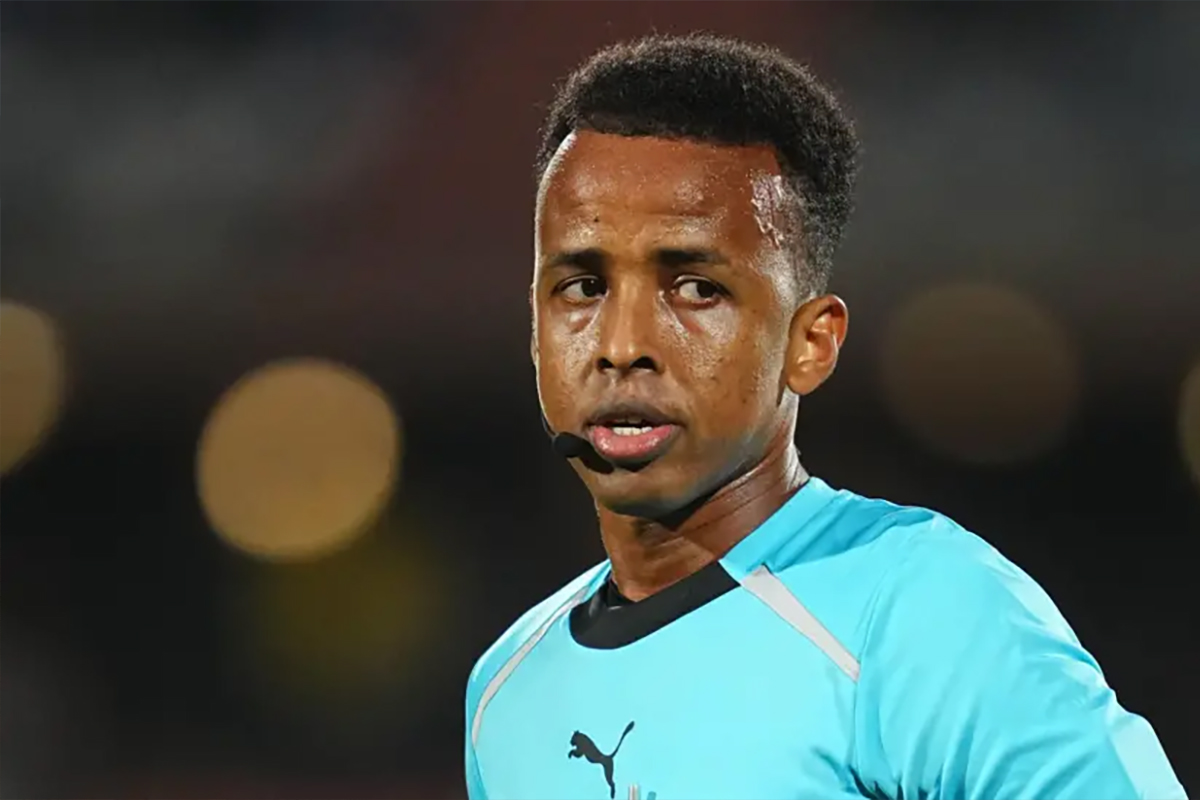
That is the question raised by the case of Omar Abdulkadir Artan, the Somali referee who was expected to become the first Somali to officiate at a FIFA World Cup finals. Instead, he has become something else: a symbol of the contradiction at the heart of global sport.
Artan was denied entry into the United States after arriving at Miami International Airport from Istanbul. U.S. Customs and Border Protection claimed he was found inadmissible because of unspecified “vetting concerns.” FIFA later confirmed that Artan would be unable to train and officiate at the 2026 FIFA World Cup. FIFA also said it was not involved in host-country immigration decisions.
That may be procedurally true. But morally, it is not enough.
Because if FIFA can appoint an African referee to the World Cup but cannot ensure that he reaches the World Cup, then the issue is no longer simply American immigration law. It is the integrity of the World Cup itself.
Who Is Omar Artan?
Omar Abdulkadir Artan is not an ordinary traveller. He is a FIFA-listed referee from Somalia. He had been named among the 52 referees selected for the 2026 FIFA World Cup, part of a wider group of 170 match officials drawn from all six confederations and 50 member associations.
His appointment mattered beyond football. Somalia has never been a heavyweight in global football politics. Its national team has not shaped World Cup history. Its institutions have had to carry the burdens of conflict, weak state capacity and international stereotyping. For a Somali referee to rise through that terrain and reach the World Cup finals was not just a personal achievement. It was a national breakthrough.
Artan had also been recognized on the continent. He was CAF’s Best Male Referee for 2025. That recognition matters because African referees often carry a double burden. They must prove competence on the field and then prove legitimacy in a global football culture that too often treats European and South American football institutions as the default standard.
For Artan, the World Cup was supposed to be a door opening. Instead, it became a door slammed shut.
What Exactly Happened?
FIFA selected Artan as part of its 2026 World Cup officiating team. The tournament, hosted by the United States, Canada and Mexico, is the largest in World Cup history, with 48 teams and 104 matches.
Artan travelled from Istanbul to Miami. On arrival, he was subjected to additional inspection by U.S. immigration authorities. He was then denied entry. U.S. officials cited “vetting concerns” but did not publicly provide detailed reasons.
FIFA confirmed that Artan would not be able to train or officiate at the World Cup. It stated that it does not control immigration processes in host countries and that authorities had informed it that Artan’s status would not be changed at present.
Somalia is among the countries affected by travel restrictions introduced under President Donald Trump’s administration. The U.S. government has justified the restrictions on national security grounds. But Artan’s case raises a serious question: can a global tournament remain global when an accredited official can be excluded because of the passport he carries?
There are still unanswered questions. Did Artan have a valid U.S. visa? Reports say yes, but U.S. authorities have not publicly detailed the full record. Was the denial directly caused by the travel ban, by separate vetting concerns, or by both? That also remains unclear. Did FIFA or the U.S. government seek any special exemption for FIFA-accredited officials from affected countries? The public record does not yet answer this.
That uncertainty is not a small detail. It is part of the problem. The opacity of immigration power is itself a form of power.
How Many World Cups Have There Been?
The men’s FIFA World Cup began in 1930 in Uruguay. It has been held every four years except in 1942 and 1946, when the tournament was cancelled because of the Second World War.
By the end of Qatar 2022, there had been 22 completed men’s World Cup tournaments. The 2026 tournament is the 23rd edition.
Across nearly a century of World Cup history, the tournament has lived through fascism, war, apartheid, Cold War politics, boycotts, dictatorship, decolonization, sanctions and globalization. Yet documented cases of FIFA-appointed match officials being selected for the World Cup finals and then denied entry into the host country appear to be extremely rare. In fact, I didn’t find any. Omar Artan’s case may be one of the clearest and most disturbing examples of a World Cup match official being blocked at the border of a host country after selection.
There have been other politically charged mobility problems in football. Teams, fans, journalists and officials have faced visa delays and denials in different competitions. Ahead of the 2026 World Cup, there have also been reports of visa complications affecting Iranian officials, African journalists and fans from several countries. But the Artan case stands out because he was not merely a supporter or private traveller. He was part of the tournament’s official machinery.
A referee is not decoration. A referee is part of the competition itself.
Why This Is Morally Wrong
The moral wrong begins with the idea of collective suspicion.
If an individual is denied entry because of specific evidence that he poses a concrete risk, the state should be able to explain that in a lawful and accountable way, even if some details must remain confidential. But if a person is effectively punished because he comes from a country on a politically designated list, then the logic shifts from individual responsibility to collective suspicion.
That is deeply dangerous.
Sport is built on the idea that the field should judge performance, not passports. FIFA selected Artan because of his competence. CAF recognized him because of his excellence. Somalia celebrated him because he had carried its name to a stage where the country has rarely been represented.
Then the border judged him differently.
This is why the issue cuts so deeply. Artan did not lose a match. He did not fail a fitness test. He was not removed because of poor officiating. He was blocked by immigration power before he could even enter the field of play.
That is not just an administrative incident. It is a moral injury.
It tells a young Somali child that talent can take you to the edge of history, but your passport can still pull you back. It tells Africa that excellence may be applauded by international sport and still be humiliated by international politics. It tells the world that the World Cup may be universal in branding but unequal in access.
FIFA’s Own Principles Are Now on Trial
FIFA’s statutes commit the organization to human rights and non-discrimination. Article 4 of the FIFA Statutes prohibits discrimination against a country, person or group on grounds including national origin, ethnic origin, religion, political opinion, birth or other status.
This does not automatically mean FIFA can override U.S. immigration law. It cannot. The United States remains a sovereign state. It controls its borders. It may deny entry to non-citizens under domestic law, including on national security grounds.
But that does not end the matter.
FIFA is not a helpless guest at its own tournament. It awards hosting rights. It negotiates host-country obligations. It sets tournament conditions. It demands stadiums, tax exemptions, broadcast guarantees, commercial protections, security arrangements and infrastructure commitments. It cannot be powerful when money is involved and powerless when human dignity is involved.
If the World Cup requires host countries to guarantee the smooth movement of teams, officials, media and tournament personnel, then FIFA must treat Artan’s exclusion as a governance failure. If such guarantees were weak, then FIFA must explain why it awarded hosting rights without stronger protections. If such guarantees existed, then FIFA must explain why they failed.
Either way, FIFA has questions to answer.
The Legal Question: Wrong, But Is It Illegal?
The legal position is more complicated than the moral one.
Under international law, states generally have broad authority to decide who enters their territory. A visa does not always guarantee admission. Border officers can still determine inadmissibility at the point of entry.
That gives the United States a strong domestic legal shield.
However, several legal and quasi-legal questions remain arguable.
First, did the host-country commitments made to FIFA include obligations to facilitate entry for accredited match officials? If yes, then Artan’s exclusion may raise issues under the host agreement or related government guarantees, even if Artan himself is not a direct party to those agreements.
Second, did FIFA have an obligation under its own rules and human rights policy to take stronger steps to protect an appointed official from discriminatory exclusion? That question may fall within FIFA governance, ethics and human-rights procedures.
Third, could Artan or the Somali Football Federation raise the matter before the Court of Arbitration for Sport? That would depend on the legal instrument being challenged, whether there is a FIFA decision capable of appeal, and whether Artan has standing. A direct challenge to U.S. border action would not belong before CAS. But a challenge to FIFA’s handling of his appointment, removal or compensation may be more plausible.
Fourth, could Somalia pursue diplomatic recourse? Yes. Somalia’s government can formally request reasons, seek reconsideration, demand an exemption or protest the treatment of a national serving in an official international sporting capacity.
Fifth, could the African Union intervene? It cannot force the United States to admit Artan. But it can make a political and diplomatic intervention, especially if the case is treated as part of a wider pattern of discriminatory mobility restrictions affecting African citizens, officials, journalists and fans.
The legal path may be narrow. The moral path is wide open.
What Recourse Does Omar Artan Have?
Artan’s possible recourse falls into several categories.
He can request a written explanation from U.S. authorities, though immigration systems often provide limited detail in cases involving security or vetting concerns.
He can seek legal advice in the United States to determine whether any waiver, review or administrative remedy is available. That may be difficult, especially if the decision is linked to national security, but it should not be dismissed without expert review.
He can ask FIFA for formal clarification of his status: Was he removed, suspended, replaced, or merely rendered unavailable? That distinction matters for his professional record.
He can seek compensation from FIFA if he suffered professional, financial or reputational loss after being selected and then prevented from participating through no fault of his own.
He can request that FIFA preserve his World Cup appointment in the historical record. Even if he does not officiate a match, he should not be erased from the story.
Most importantly, Artan should not be left to fight alone. His case is bigger than one man. It belongs to Somalia, CAF, the African Union and all football nations that believe global sport must not become a servant of discriminatory border regimes.
What Should Somalia Do?
Somalia should respond with dignity, precision and firmness.
First, it should request a full diplomatic explanation from the United States. Not social-media outrage. Not vague disappointment. A formal note verbale.
Second, it should ask FIFA to disclose what steps were taken before and after Artan’s denial of entry. Did FIFA know there was a risk? Did it request assurances? Did it escalate the matter to the highest level of the Local Organising Committee and the U.S. government?
Third, Somalia should work with CAF to ensure that Artan’s professional future is protected. This incident should not reduce his international assignments. If anything, FIFA and CAF should publicly reaffirm their confidence in him.
Fourth, Somalia should ask the African Union to treat the matter as part of a wider question of African mobility in global events. African passports already face some of the harshest visa regimes in the world. When those restrictions enter the World Cup, they cease to be private inconveniences. They become structural exclusion.
What Should the African Union Do?
The African Union should not treat this as merely a Somali issue.
It should ask a simple question: if African officials can be selected for global tournaments but denied entry by host countries, what does equal participation mean?
The AU can issue a statement calling for non-discriminatory access for all accredited African participants in global sporting events. It can request consultations with FIFA, CAF and the U.S. government. It can place the issue within the broader diplomacy of African mobility, visa equity and equal treatment.
The AU should also push for future mega-sporting host agreements to include strong, public and enforceable guarantees for all accredited participants, regardless of nationality, religion, race or political origin.
Africa should not wait until its people are humiliated at airports before demanding dignity.
What Should FIFA Do?
FIFA should do five things immediately.
First, it should publish a fuller explanation of what happened, while respecting Artan’s privacy.
Second, it should formally protest the denial of entry if it believes Artan had been properly accredited and cleared.
Third, it should seek an urgent exemption or review from U.S. authorities.
Fourth, it should compensate Artan if he has lost income, opportunity or career advancement because of the incident.
Fifth, it should review host-country guarantees for future tournaments. No country should host the World Cup without clear, enforceable commitments that all accredited teams, referees, officials, media and tournament personnel will be granted fair and non-discriminatory access, subject only to individualized and transparent security concerns.
FIFA cannot continue to hide behind sovereignty while profiting from universality. The World Cup is valuable precisely because it claims to belong to the world. If the world cannot enter, the brand becomes a lie.
The Deeper African Meaning
This case hurts because it is familiar.
Africa knows what it means to be invited into global rooms and then treated as suspect at the door. African athletes are celebrated when they run, score, fight, dance and entertain. African officials are welcomed when they serve the spectacle. But African passports remain among the most disrespected documents in the global mobility system.
Artan’s exclusion is therefore not just about football. It is about the hierarchy of human movement.
Some people cross borders as tourists. Others cross as investors. Others cross as diplomats. Too many Africans cross as suspects, even when they come carrying official letters, professional credentials and global appointments.
This is the scandal beneath the scandal.
A Somali referee did everything football asked of him. He rose through the ranks. He earned continental respect. He entered FIFA’s elite list. He carried Somalia to the edge of history.
Then the border said no.
The World Cup Cannot Be Universal Only on Television
The World Cup is watched everywhere. In Mogadishu. In Nairobi. In Dakar. In Lagos. In Johannesburg. In Accra. In Cairo. In Kinshasa. In every village where boys and girls kick balls made of plastic bags, old socks or hope.
But watching is not the same as belonging.
If Africa can watch the World Cup but African officials can be stopped from participating, then the World Cup is not fully global. It is globally consumed but unequally accessed.
Omar Artan’s case forces FIFA, the United States, Somalia, CAF and the African Union to confront a hard truth: global sport cannot keep pretending that politics ends at the stadium gate. Politics is already at the airport. Politics is already in the visa queue. Politics is already in the passport.
The question is whether football will challenge that politics or quietly obey it.
Omar Artan deserved the field. Somalia deserved the moment. Africa deserved the dignity of seeing one of its own make history without being stopped at the border.
The World Cup must now decide what it really is.
A tournament for the world.
Or a tournament watched by the world, controlled by borders, and governed by the old inequalities it claims to transcend.