








There are political conferences that merely fill halls, pass resolutions and produce photographs for the evening news. Then there are political conferences that reveal the direction in which a country is moving.
The first congress of PASTEF-Les Patriotes, held in Senegal in June 2026, belonged to the second category.
It was not simply an internal gathering of a ruling party. It was a moment of consolidation for a movement that began in January 2014 as a rebellion of young Senegalese professionals against corruption, elite capture, foreign dependency and political fatalism. Twelve years later, that movement had travelled an extraordinary road. It had survived repression. It had seen its leader, Ousmane Sonko, jailed, disqualified, demonized and politically resurrected. It had carried Bassirou Diomaye Faye to the presidency. It had transformed itself from an insurgent opposition force into the central pole of Senegalese power.
But the congress also took place at a delicate and dramatic moment.
By June 2026, the relationship between President Bassirou Diomaye Faye and Ousmane Sonko had entered a period of open tension. Sonko had been removed from the office of Prime Minister on May 22, 2026. Four days later, on May 26, he became President of Senegal’s National Assembly. That meant that as PASTEF gathered its delegates, militants, diaspora structures and allies, it was not merely celebrating political success. It was also asking a deeper question: who owns the revolution that brought the current order to power?
Is it the presidency? Is it the party? Is it the people? Or is it the long historical movement that produced all three?
That is why the PASTEF congress mattered.
A Congress Held in the Shadow of Power and Fracture
The congress was held on June 6, 2026, in Diamniadio, outside Dakar, at Abdou Diouf International Conference Center.
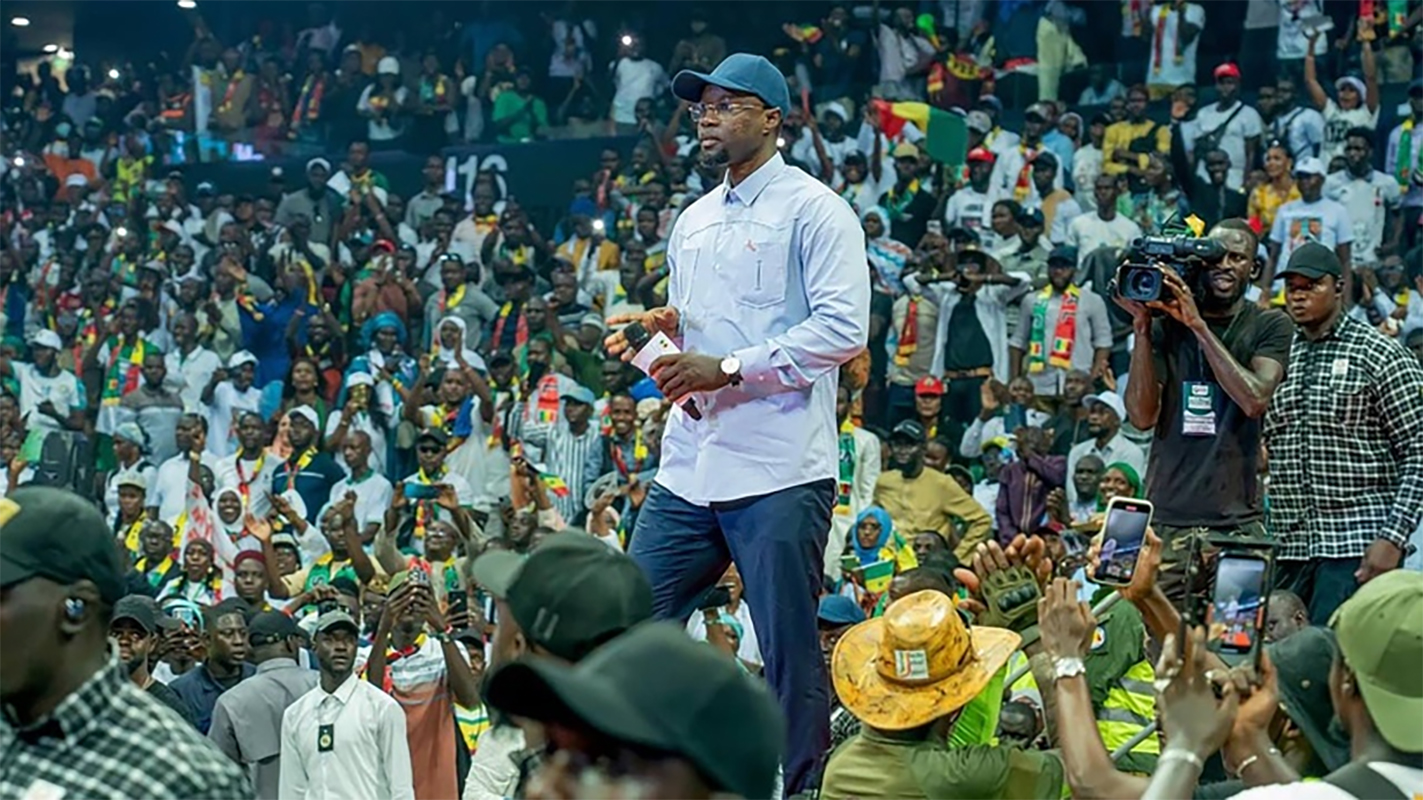
It was followed by a public rally the next day, Sunday, June 7, 2026, at Dakar Arena, where Ousmane Sonko was officially presented for the 2029 presidential race.
Diamniadio is part of Senegal’s state-building geography, a planned urban and administrative extension beyond Dakar. CICAD is a site of official architecture, national ceremony and regional visibility. Dakar Arena is a theatre of mass politics, where numbers become message and bodies become political grammar.
PASTEF understood this symbolism.
The congress gathered more than 1,200 delegates, including representatives from Senegal’s territorial structures and the diaspora. Secretary General Ayib Daffé later stated that the congress drew delegates from PASTEF’s 553 local branches across Senegal, as well as participation from 45 diaspora branches. That structure reveals something important about PASTEF’s political machine. It is not merely a Dakar-based party orbiting around one charismatic man. It has built cells, branches, local structures, diaspora channels and ideological organs that allow it to operate as a national and transnational movement.
The participants included Ousmane Sonko, the re-elected president of PASTEF; Ayib Daffé, the party’s Secretary General; members of the party’s national structures; delegates from local branches; diaspora representatives; elected officials; allied political movements; and foreign delegations that included people like Kenya’s Senator Okiya Omtatah. He is Kenya’s most renowned public litigant who has led the legal fight against odious debt for years.
The party’s High Authority for the Regulation of the Party, known by its French acronym HARP, played a role in validating the presidential candidacy process.
Notably absent from the congress was President Bassirou Diomaye Faye. His absence was not a minor protocol detail. It hung over the congress like a silent paragraph in the middle of a national speech.
Who Were the Participants and How Were They Chosen?
The congress was built around a delegate system. Delegates came from 553 local branches across Senegal. These branches represent the party’s national infrastructure across communes, departments and regions. The diaspora was also present through 45 branches, underscoring one of PASTEF’s strongest political characteristics: its ability to turn Senegalese citizens abroad into ideological, financial and digital actors in national transformation.
The selection process appears to have followed party structures rather than open public attendance. In other words, this was not merely a rally for supporters. It was a congress of recognized party organs, delegates and branches. The distinction matters. A rally displays popularity. A congress displays organization.
PASTEF had both.
The June 7 rally at Dakar Arena then translated the internal decisions of the congress into public spectacle. If the June 6 congress was the engine room, Dakar Arena was the thunderclap.
What Happened During the Congress?
The most important outcome was the re-election of Ousmane Sonko as president of PASTEF-Les Patriotes. He was elected unanimously by voting delegates, giving him a new six-year mandate at the head of the party.
This was no ordinary internal vote.
It was a reaffirmation of Sonko’s centrality at a time when the party-state relationship had become tense. After his dismissal as Prime Minister, and after the formation of a new government under Prime Minister Ahmadou Al Aminou Lô, Sonko had instructed PASTEF members not to participate in the new executive. Some officials nevertheless joined the government, creating disciplinary tensions within the party.
Against that background, Sonko’s unanimous re-election sent a clear message: whatever was happening inside the state, the party remained loyal to its founding leader.
The congress also adopted several key documents. These included a general resolution, an ideological charter, a strategic orientation document, a code of ethics for activists, motions, special resolutions and the general activity report. Together, these documents sought to answer a central question facing every revolutionary party that reaches power: how do you prevent victory from dissolving the movement that made victory possible?
The congress placed sovereignty at the centre of PASTEF’s political doctrine. Sonko declared that sovereignty is not decreed, but organized. That line is politically important because it moves sovereignty from slogan to system. For PASTEF, sovereignty is not merely about flag, anthem and presidential speeches. It is about institutions, economic decisions, corruption control, regional alliances, strategic state capacity and the moral discipline of public leadership.
The congress also reaffirmed the “spirit of rupture” that brought PASTEF to power. In Senegalese political language, rupture means breaking from old systems of patronage, foreign dependency, elite compromise and cosmetic democracy. It is a demand for transformation, not mere alternation.
The Fusion Charter and the Politics of Expansion
On June 5, 2026, one day before the congress, PASTEF organized a signing ceremony for a charter of fusion at Hôtel Azalaï. Around sixty political parties and citizen movements reportedly joined PASTEF through this process.
This was one of the most politically significant developments of the congress weekend.
It showed that PASTEF was not only consolidating internally. It was absorbing allies, movements and smaller political formations into a larger political architecture. This matters because ruling parties face two dangers after victory. One is fragmentation. The other is isolation. By bringing dozens of political and civic formations into its orbit, PASTEF attempted to solve both problems at once.
But fusion also carries risks.
A movement that grows too quickly can dilute its ideological clarity. A party born from discipline can become vulnerable to opportunists. A revolutionary formation can become crowded with latecomers who love power more than sacrifice. PASTEF’s adoption of a code of ethics suggests that the party understands this danger. The question is whether the code will become a living discipline or simply another document in the archive of African ruling parties.
The Pan-African Component
The Pan-African dimension of the congress was not ornamental. It sits at the heart of PASTEF’s self-understanding.
PASTEF’s official values include democracy, patriotism, Pan-Africanism, work, ethics and fraternity. The congress reaffirmed this ideological identity by linking Senegal’s internal transformation to Africa’s wider struggle for sovereignty. The adopted political line emphasized regional cooperation and the construction of an African power capable of defending its strategic interests.
That phrase deserves attention.
For decades, African politics has been trapped between national flags and external systems. Countries became independent, but their currencies, military partnerships, trade structures, debt relationships, education systems and elite aspirations often remained tied to former colonial powers and global financial institutions. PASTEF’s Pan-Africanism seeks to confront that contradiction.
The congress therefore spoke not only to Senegal, but to West Africa.
It spoke to Mali, Burkina Faso and Niger, where sovereignty politics has taken dramatic and controversial forms. It spoke to Guinea, Ghana, Nigeria, Côte d’Ivoire, The Gambia and the wider ECOWAS region, where young Africans are demanding governments that answer to their citizens before answering to Paris, Washington, Brussels or the IMF. It spoke to the African diaspora, whose political imagination has often moved faster than formal diplomacy.
Sonko’s Message: The Revolution Is Not an Individual Career
One of the most powerful themes of Sonko’s congress message was the idea that the Senegalese revolution does not rest on individual trajectories. It rests on a people, a party, a movement, a collective historical consciousness and a strategic orientation.
That statement was both philosophical and political.
Philosophically, Sonko was warning against the personalization of revolutionary struggle. Politically, he was speaking into the tension between party legitimacy and state authority. His message suggested that no individual, however highly placed in the state, should detach himself from the popular force that made his rise possible.
The line was widely read in relation to President Bassirou Diomaye Faye, even though Sonko did not need to name him directly. In politics, silence sometimes names more loudly than speech.
This is what made the congress so explosive. It was not just a celebration of party discipline. It was a reminder that PASTEF sees itself as the mother ship of Senegal’s current transformation. The presidency may occupy the summit of the state, but PASTEF sees the party and the people as the source of legitimacy.
That is a powerful claim. It is also a dangerous one if not carefully managed.
Every liberation movement that becomes a ruling party must confront the same tension: how to preserve the movement without suffocating the state; how to discipline leaders without undermining institutions; how to keep revolutionary fire alive without burning the constitutional house.
The Outcomes of the Conference
The congress produced several clear outcomes.
First, Ousmane Sonko was renewed as PASTEF president for a six-year mandate.
Second, the party adopted major doctrinal and organizational documents, including an ideological charter, a strategic orientation document, resolutions, motions, a code of ethics and an activity report.
Third, the congress reaffirmed sovereignty as the central pillar of PASTEF’s political doctrine.
Fourth, the party strengthened its internal structures by bringing together delegates from hundreds of local branches and dozens of diaspora branches.
Fifth, the broader congress weekend expanded PASTEF’s political base through the fusion charter signed at Hôtel Azalaï by around sixty political parties and citizen movements.
Sixth, the Dakar Arena rally converted the congress from an internal political event into a mass mobilization moment.
Seventh, PASTEF set ambitious organizing targets: 100,000 functional cells and one million members.
These outcomes show a party preparing not merely to govern today, but to dominate tomorrow.
How the Congress Galvanized PASTEF
The congress galvanized PASTEF in at least five ways.
First, it restored emotional momentum. After weeks of tension surrounding Sonko’s removal from the prime ministership, the congress allowed militants to rally around a familiar figure, a familiar language and a familiar mission.
Second, it clarified authority. Sonko’s re-election affirmed that he remains the undisputed leader of the party, regardless of shifts inside the executive branch.
Third, it gave the movement documents. Revolutions need memory, but parties need texts. Charters, resolutions, codes and strategic documents help transform energy into instruction.
Fourth, it expanded the base. The fusion of dozens of political and civic organizations into PASTEF signals that many actors now see the party as the central vehicle of Senegal’s future politics.
Fifth, it moved the party from survival mode to construction mode. For years, PASTEF organized under pressure, repression and exclusion. The June 2026 congress suggested that it now wants to organize as a durable governing force.
That is a major transition.
The party of resistance is trying to become the party of architecture.
The Risks Ahead
But the congress also revealed serious risks.
The first risk is dual power. If the presidency and the party move in different directions, Senegal could enter a period of institutional tension and constitutional crisis. President Bassirou Diomaye Faye holds constitutional authority. Ousmane Sonko holds immense party authority and now parliamentary authority. If those two centres of gravity compete instead of coordinating, the national project could suffer.
The second risk is overcentralization. PASTEF’s strength has always been tied to Sonko’s charisma, courage and symbolic power. But a party that depends too heavily on one man can struggle to build a self-renewing institutional culture.
The third risk is ideological inflation. Sovereignty, rupture and Pan-Africanism are powerful words. But citizens will eventually ask concrete questions. Where are the jobs? Where is the cheaper cost of living? Where is the corruption prosecution? Where is the industrial strategy? Where is the agricultural transformation? Where is the debt plan? Where is the new relationship with France, ECOWAS and global finance?
The fourth risk is managing newcomers. The absorption of around sixty parties and movements is impressive, but it also requires discipline. Some will come with conviction. Others may come with shallow opportunism.
The fifth risk is public impatience. Movements rise on hope. Governments survive on delivery.
What Next?
After the congress, PASTEF’s next task is to turn mobilization into measurable transformation.
The party must build the 100,000 functional cells it has promised. These cells must not become empty shells or patronage committees. They must become instruments of civic education, accountability, policy feedback and local organization.
It must register and retain the one million members it seeks. Membership must mean more than a card. It should mean ideological training, ethical commitment, financial contribution, local service and political discipline.
It must manage relations with President Bassirou Diomaye Faye and Prime Minister Ahmadou Al Aminou Lô. The party cannot afford a destructive war between the state and the movement that birthed the state. Senegal needs clarity, not permanent suspense.
It must translate sovereignty into policy. This means serious work on debt, extractives, agriculture, industrialization, currency questions, public procurement, anti-corruption, education, energy and regional diplomacy.
It must deepen its Pan-African alliances without reducing Pan-Africanism to rhetoric. Senegal’s transformation will matter more if it strengthens African cooperation, not if it merely replaces one dependency with another.
Most importantly, PASTEF must protect the moral capital that brought it to power. The martyrs, prisoners, activists, young voters, diaspora organizers and ordinary Senegalese citizens who carried the movement did not sacrifice for cosmetic change. They sacrificed because they believed Senegal could be governed differently.
Conclusion: A Party Organizes, A Country Watches
The PASTEF congress did more than organize a party.
It announced the next phase of Senegal’s political awakening.
At Diamniadio, PASTEF told Senegal that it intends to remain the ideological engine of the national transformation. At Hôtel Azalaï, it expanded its political family. At Dakar Arena, it displayed its mass energy. Through Ousmane Sonko’s re-election, it reaffirmed its founding authority. Through its resolutions, it placed sovereignty, ethics and Pan-Africanism at the centre of its doctrine.
But history is never impressed by declarations alone.
The real test now begins.
Can PASTEF remain disciplined while growing rapidly? Can it support the state without becoming swallowed by it? Can it challenge the presidency without destabilizing the republic? Can it turn sovereignty from a slogan into bread, jobs, justice, factories, farms, schools, dignity and African power?
That is the question after the congress.
Because in Senegal today, PASTEF is no longer merely asking to be heard.
It is asking to define the future.